
Crisis Communications Strategy
Freelance Crisis Communications Consultant: process built before the crisis hits
I'm Robbie Centellas, a freelance crisis communications consultant based in London. I help organisations build the governance, message discipline and spokesperson readiness that make the difference in the first sixty minutes of a real crisis.
I led communications through the UK energy crisis while at Uswitch, across regulatory, media and consumer audiences, and worked with Novo Nordisk's clinical team on crisis-ready messaging in consumer health, a category where accuracy is not optional.
Explore the freelance crisis communications services I offer.
Why process matters more than instinct in a crisis
Crisis communications is the discipline most likely to be judged not on the strategy document written months in advance, but on the decisions made in the first sixty minutes of an actual crisis. That reality shapes everything about how the discipline needs to be built. Good crisis communications is not primarily about having the right instincts in the moment; it is about having built the right process, governance and framework long before the moment arrives, so that instinct has something solid to operate within rather than working from a standing start under enormous pressure.
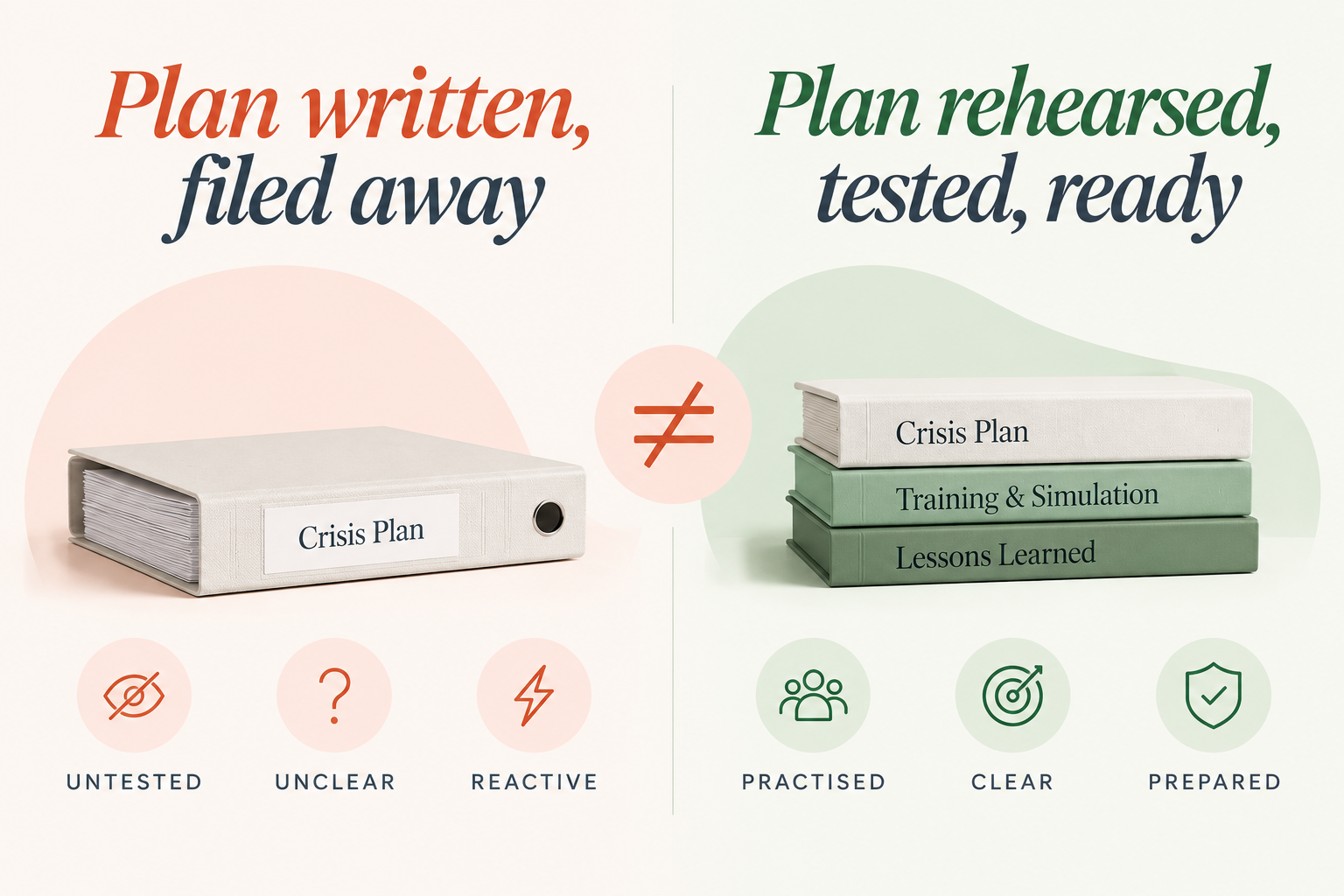
Organisations that treat crisis communications as a plan to write once and file away consistently underperform when a real crisis hits, regardless of how talented their communications team is.
The organisations that know how to manage a communications crisis well, are almost always the ones that have rehearsed the process, clarified decision making authority in advance, and built the legal and clinical frameworks needed to move quickly without moving recklessly.
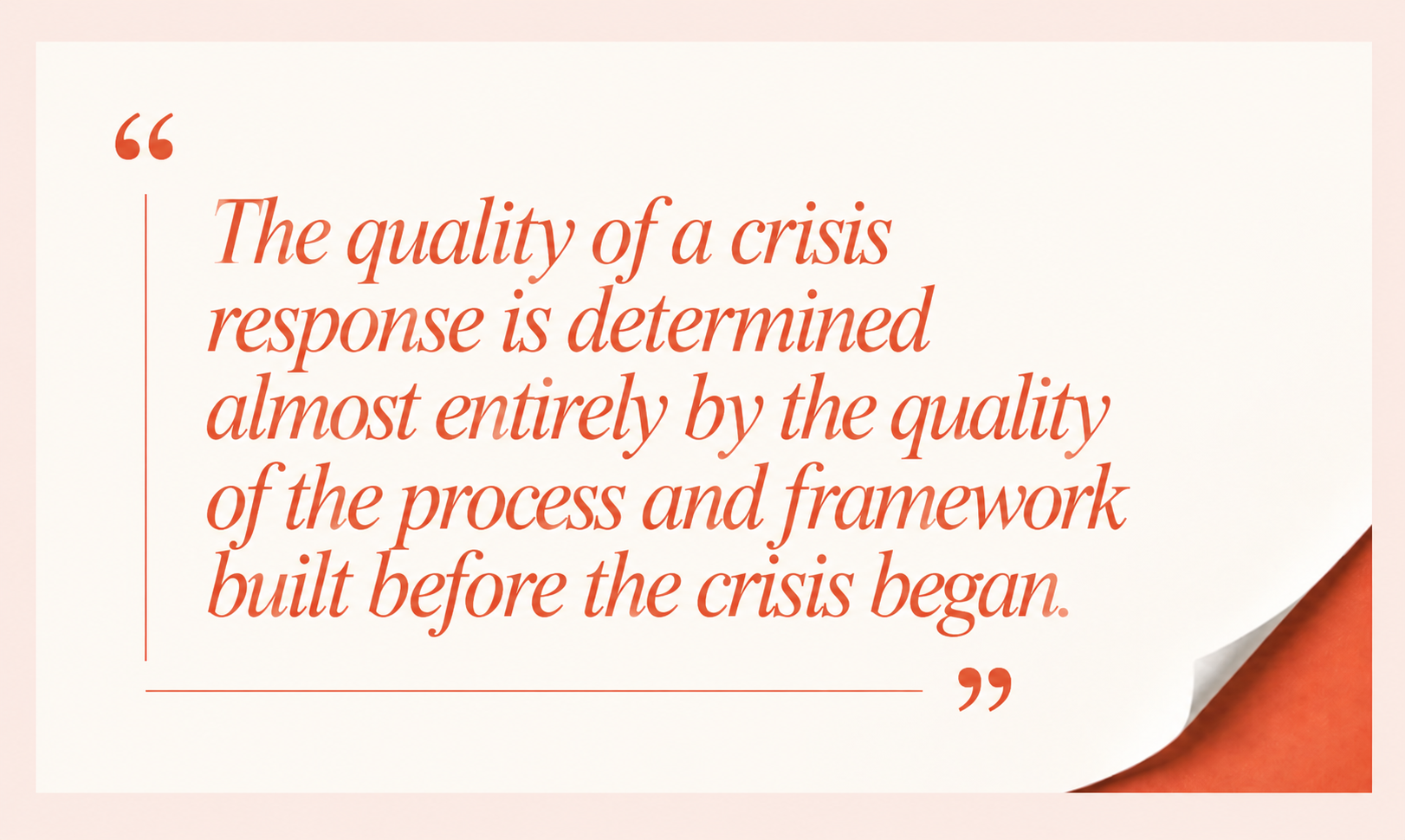
I've worked in categories, including consumer finance and regulated healthcare sectors, where the margin for error in a crisis is low, where a communications misstep can carry real regulatory, legal or patient safety consequences, not just reputational ones. That experience has shaped a clear view, the quality of a crisis response is determined almost entirely by the quality of the process and framework built before the crisis began.
What crisis communications actually covers
Crisis communications is the discipline of preparing for, managing and communicating through events that pose a significant threat to an organisation's reputation, operations, financial position or, in the most serious cases, to public safety. It spans the full lifecycle of a crisis, from pre-crisis planning and risk identification, through the acute response phase, to post-crisis recovery and reputation rebuilding.
The core components of a strong crisis communications capability include
Risk identification and scenario planning, mapping the specific crises most likely to affect the organisation and building response plans in advance
Governance and decision-making protocols, establishing clearly in advance who has authority to approve messaging, make key decisions and speak publicly during a crisis
Legal and regulatory frameworks, ensuring every crisis response process is built in real partnership with legal and compliance functions, not developed in isolation and checked only at the point of crisis
Spokesperson readiness, ensuring the right people are trained, briefed and available to represent the organisation credibly under pressure
Monitoring and early warning systems, building the capability to identify emerging issues before they escalate into full crises
Stakeholder communication protocols, having pre-built plans for how different audiences, employees, customers, media, regulators, will be communicated with during an active crisis
Post-crisis review and reputation recovery, treating the period after a crisis as a distinct phase requiring its own deliberate communications approach
The core pillars of a crisis communications strategy
Risk identification and scenario planning
Effective crisis communications starts long before any actual crisis, with a clear eyed assessment of the specific risks an organisation faces. This is not a generic exercise, the risks facing a healthcare brand, a financial services company and an energy provider are meaningfully different, and a crisis plan built from a generic template rather than real scenario mapping tends to fall apart under the specific pressures of a real event.
Proper scenario planning involves working across the business, with legal, operations, HR and senior leadership, to identify the crises most likely to occur and most damaging if they did, then building specific response frameworks for each, rather than relying on a single generic plan to cover every eventuality.
Governance and decision making protocols
One of the most common failure points in a real crisis is confusion over who has authority to make decisions and approve messaging. When that clarity does not exist in advance, precious time is lost in the acute phase of a crisis simply establishing who needs to sign off on what, exactly when speed matters most.
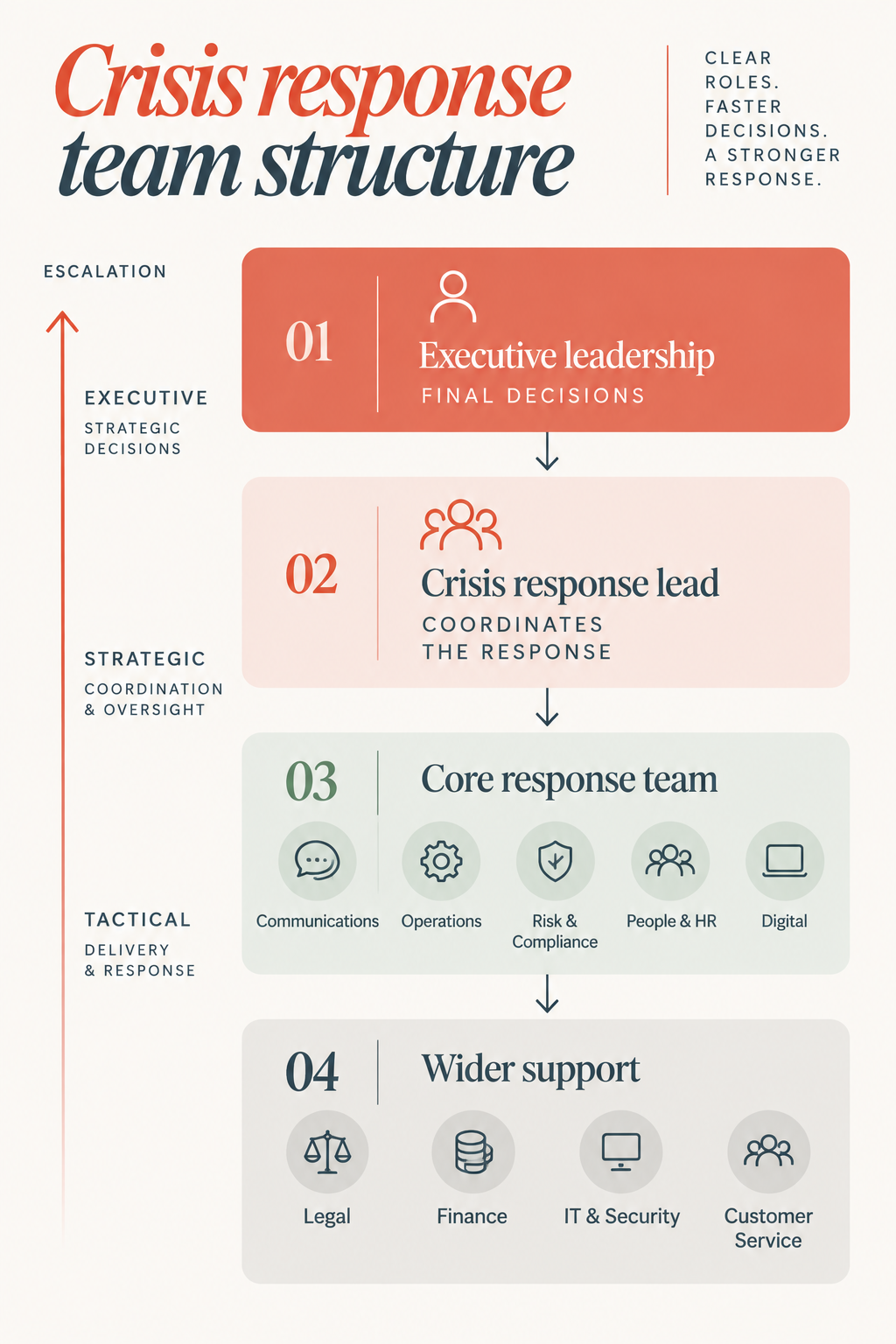
A strong governance framework defines in advance who sits on the crisis response team, what authority each person holds, how quickly decisions need to be escalated and to whom, and critically, who has the authority to speak publicly on the organisation's behalf. This framework needs real buy in and rehearsal before a crisis, not just documentation that exists on paper.
Legal and regulatory frameworks
This is where crisis communications differs most significantly from other communications disciplines, and where its rigour needs to be highest. Every crisis response, from the language used in a public statement to the timing of when information is disclosed, carries potential legal and regulatory implications, and a communications team operating without close, real partnership with legal counsel is taking on risk that has nothing to do with communications skill and everything to do with process failure.
In regulated sectors specifically, health, pharmaceuticals, financial services, energy, this legal and regulatory dimension extends further, into clinical accuracy requirements, specific regulatory disclosure obligations and sector-specific compliance frameworks that a generic crisis communications plan simply does not account for. Building crisis response protocols in real, ongoing partnership with legal, regulatory and, where relevant, clinical teams, rather than treating legal review as a final check on communications that have already been drafted, is what separates crisis response that holds up under scrutiny from response that creates new problems on top of the original crisis.
I've worked directly with clinical teams, including close collaboration with Novo Nordisk's Director of Obesity and clinical team on accuracy, checking editorial and campaign content, and that experience of integrating clinical and regulatory oversight directly into the communications process, rather than treating it as a separate approval step, is directly transferable to how crisis communications frameworks need to be built in any regulated or safety-sensitive category.
Spokesperson readiness
A crisis is the highest pressure environment a spokesperson will ever face publicly, and it is not the moment to discover that training or message discipline is lacking. Strong crisis communications capability includes proper media training specifically for crisis scenarios, which is meaningfully different from general executive media training, clear message frameworks prepared in advance for likely scenarios, and real rehearsal, including simulated crisis exercises, so that the first time a spokesperson faces real pressure is not the actual crisis itself.

Monitoring and early warning systems
Many crises do not begin as crises; they begin as smaller issues that escalate because they were not identified and addressed early. A mature crisis communications capability includes real monitoring of media coverage, social sentiment, regulatory signals and internal escalation channels, so that issues can be identified and addressed while they remain manageable, rather than only becoming visible to the communications function once they have already become a full-blown crisis.
Stakeholder communication protocols
During an active crisis, different stakeholders need different information, delivered through different channels, often at the same time and under significant time pressure. Employees need honest, timely internal communication, both because it is right and because employees who feel uninformed will seek information elsewhere. Customers need clear, accurate guidance. Regulators need appropriate, often legally mandated disclosure. Media need a coordinated, consistent response. Having pre built templates and protocols for each of these audiences, developed and legally reviewed in advance, means the acute phase of a crisis can focus on judgement and adaptation rather than starting every communication from a blank page.
Crisis communications and AI search
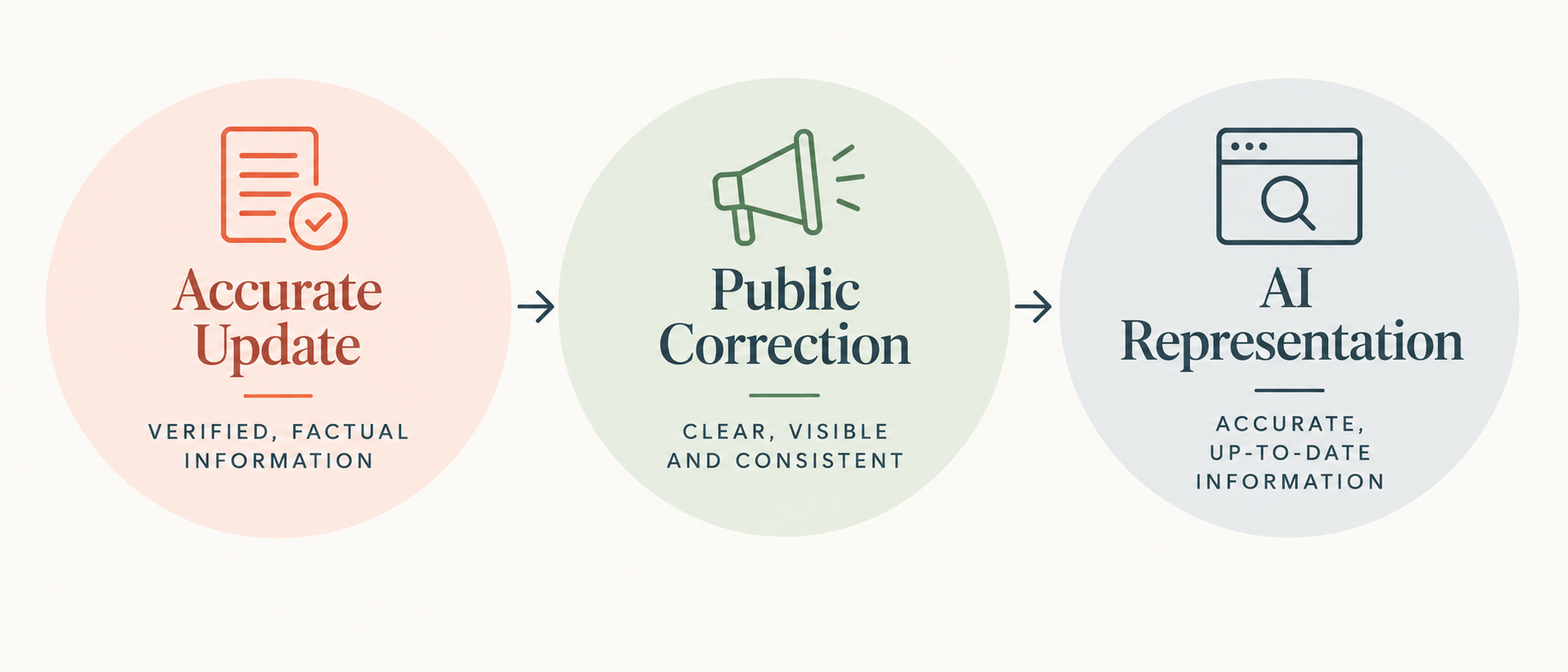
A crisis doesn't end when the headlines stop. AI tools can keep repeating old coverage for months, which is why recovery now includes AI search and brand discoverability.
A new dimension of crisis risk
The rise of AI-powered search and answer engines adds a new dimension to crisis communications risk that most existing frameworks were not built to account for. In a traditional crisis, an organisation's communications team could reasonably expect that as accurate, updated information was published, it would gradually become the dominant narrative in search results and media coverage as older or inaccurate reporting was superseded. AI-generated summaries do not necessarily work the same way, they can synthesise and repeat information without clear time weighting, meaning outdated or even inaccurate reporting from early in a crisis, before the full facts were established, can continue to be surfaced and repeated well after it has been superseded by verified, updated information.
Why this matters for crisis response process
This reinforces, rather than replaces, the fundamental discipline of good crisis communications, but it does add real urgency to a specific element of process, ensuring that accurate, authoritative, clearly dated information is published on owned channels as quickly as verified facts allow, and that any inaccurate early reporting is actively and clearly corrected on the public record, not simply left to be naturally superseded over time. In a crisis, the gap between an unverified initial report and a verified, accurate update used to close relatively predictably as a story developed. That gap can now persist much longer in how AI systems represent the situation, which means the discipline of rapid, accurate, clearly published correction matters more than it once did.
Practical considerations for AI search era crisis response
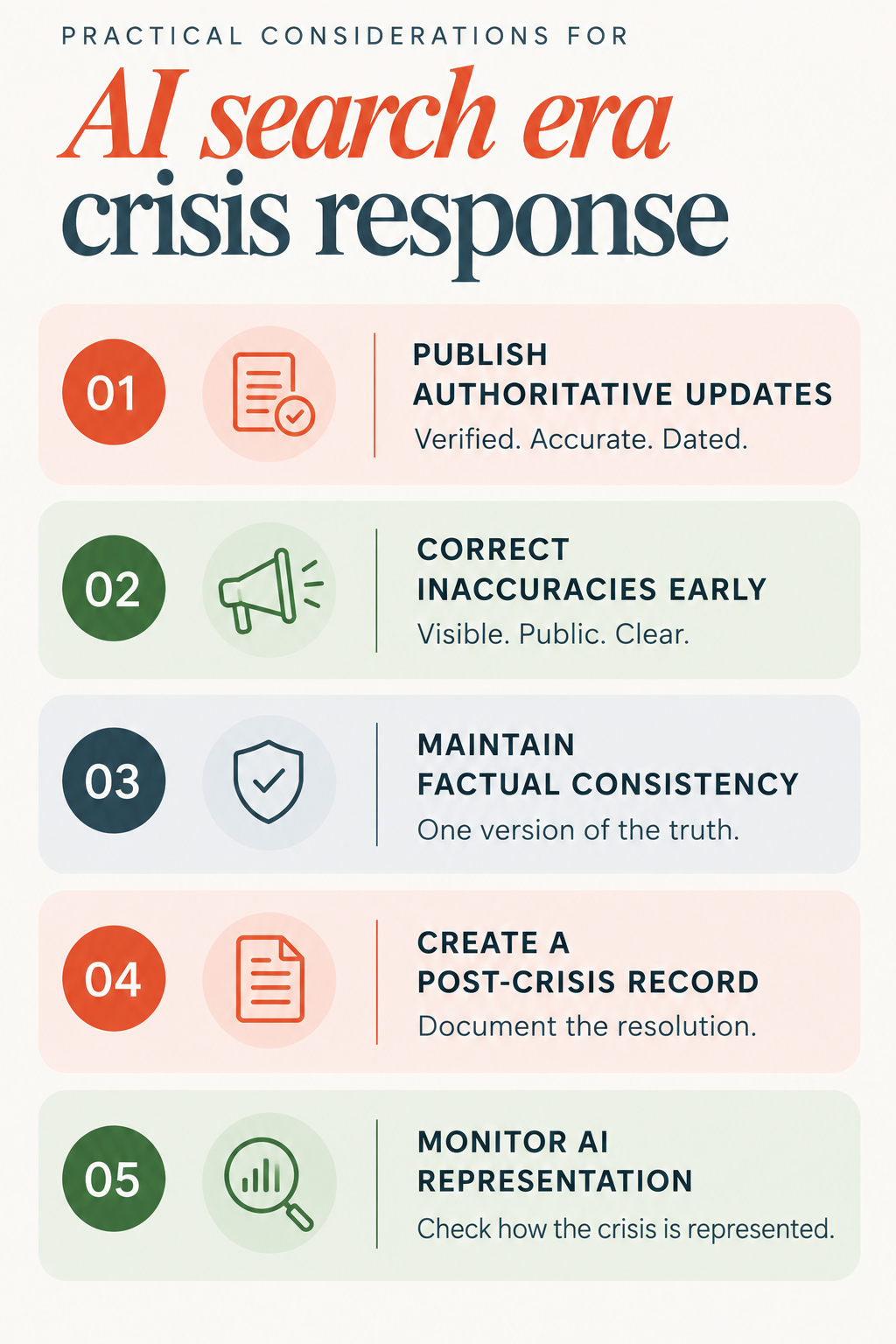
Publish clear, authoritative, accurately dated updates on owned channels as quickly as verified facts allow, since this becomes a primary source AI systems can draw from as a crisis develops
Actively and visibly correct inaccurate early reporting on the public record, rather than assuming it will naturally fade from relevance once updated information is available
Maintain absolute factual consistency across every statement and channel during a crisis, since any contradiction becomes a signal that undermines confidence in the entire response, in both human and AI evaluation of the situation
Build post crisis content that clearly and comprehensively documents the resolution and any changes made as a result, since this becomes the authoritative long term record that AI systems are more likely to draw from once the acute crisis phase has passed
Treat monitoring of AI search representation as part of the standard post crisis review process, checking how the organisation and the crisis are being represented across major AI tools, not just traditional media coverage
The underlying principle remains unchanged
For all the ways AI search adds new considerations, the underlying principle of good crisis communications has not changed. Speed, accuracy, transparency and real legal and regulatory rigour have always been what separates a crisis response that protects an organisation from one that compounds the damage. AI search simply raises the stakes on getting the process right, and extends the time horizon over which an inadequate response can continue to cause damage.
Building your crisis communications framework: a practical approach
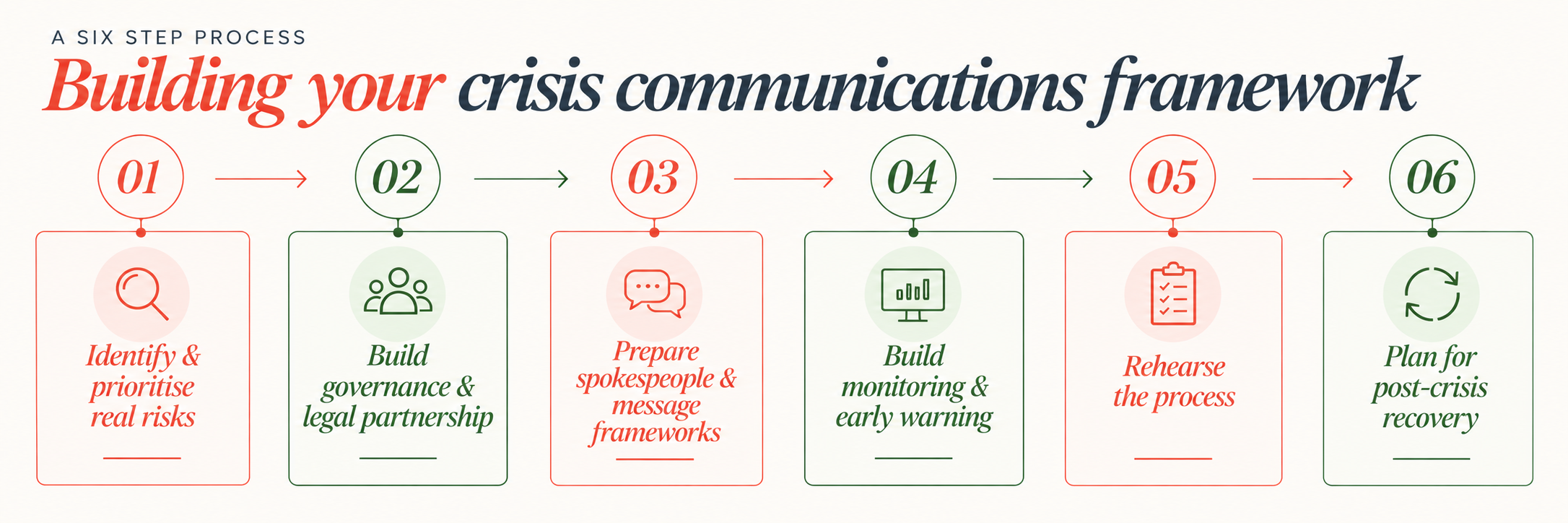
Step one: identify and prioritise real risks
Work across the business to map the specific crisis scenarios most likely to occur and most damaging if they did, rather than relying on a generic template.
Step two: build governance and legal partnership from the start
Establish clear decision-making authority and build the crisis response process in real, ongoing partnership with legal, regulatory and, where relevant, clinical teams, not as a final check on finished communications.
Step three: prepare spokespeople and message frameworks in advance
Build and rehearse message frameworks for likely scenarios, and ensure spokespeople receive real crisis-specific media training, not just general executive coaching.
Step four: build monitoring and early warning capability
Establish real ongoing monitoring so emerging issues can be identified and addressed before they escalate into full crises.
Step five: rehearse the process, not just the document
Run simulated crisis exercises regularly, testing whether the governance, decision-making, and stakeholder communication protocols actually function under pressure, not just whether the plan exists on paper.
Step six: treat post-crisis recovery as its own distinct phase
Build a deliberate plan for the period after the acute crisis passes, including public correction of any inaccurate early reporting and clear, comprehensive documentation of resolution.
Common pitfalls in crisis communications
The most damaging and most common failure is treating crisis communications as a document to be written once rather than a process to be rehearsed and maintained. Other recurring issues include building crisis plans without real legal and regulatory partnership from the outset, leaving governance and decision making authority unclear until a real crisis forces the issue, under investing in spokesperson training specifically for crisis scenarios, and failing to treat the post crisis recovery period with the same discipline as the acute response phase, allowing damage from the crisis to linger long after the acute phase has technically ended.
How this comes together in practice
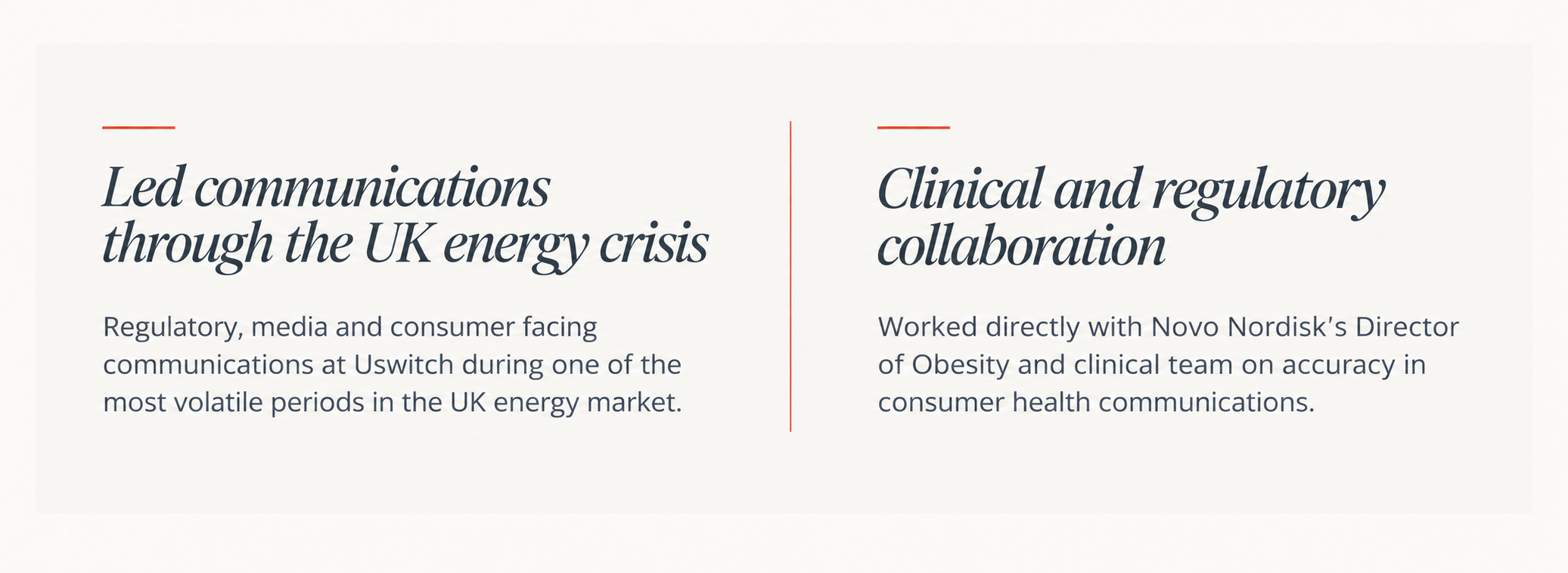
I've led communications through real high stakes moments, including navigating regulatory, media and consumer facing communications across the UK energy crisis while at Uswitch, one of the most volatile periods the UK energy market has faced, and I've built crisis and issues frameworks in consumer health, a category where clinical accuracy and regulatory compliance are not optional extras but the foundation the entire communications response has to be built on. That work has consistently reinforced the same lesson, a crisis response is only as strong as the process, governance and legal or clinical partnership built before the crisis ever began.
The instinct to communicate well under pressure matters. But instinct without process, governance and real legal and regulatory rigour is not a strategy; it is a hope. Building that process properly, well before it is needed, is the actual work of crisis communications.
Great work starts with a spark. Discover the Spark at www.robbiecentellas.com.

About the author
Robbie Centellas is a senior marketing and communications consultant with almost two decades of experience across PR, digital PR, content, corporate communications and crisis communications. His work includes leading a digital PR programme at RVU delivering 25,000+ pieces of coverage and 16,000+ high-authority backlinks, and developing the Eat Less Move More campaign with Amy Tapper and Fat Tony. Read more about Robbie.
Crisis Communications Strategy FAQs
-
Crisis communications is the discipline of preparing for and managing communications during events that threaten an organisation's reputation, operations or, in serious cases, public safety. Unlike general PR, it is built almost entirely around process, governance and legal or regulatory rigour rather than storytelling, since decisions made in the acute phase of a crisis carry legal and reputational consequences that ordinary PR campaigns do not.
-
Well before it is needed, and rehearsed regularly rather than written once and filed away. A plan built during an actual crisis is already too late, the value of preparation comes from having governance, decision-making authority and message frameworks agreed and tested in advance, so the acute phase can focus on judgement rather than process.
-
This needs to be defined clearly in advance, not decided in the moment. A strong governance framework names who sits on the crisis response team, what authority each person holds, and critically, who has final sign-off to speak publicly on the organisation's behalf, removing the delay that comes from establishing this for the first time under pressure.
-
Every element of a crisis response, from the wording of a statement to the timing of disclosure, can carry legal or regulatory implications. Building crisis protocols in ongoing partnership with legal, regulatory and where relevant, clinical teams, rather than treating legal review as a final check, is what separates a response that holds up under scrutiny from one that creates new problems on top of the original crisis.
-
AI generated summaries can repeat outdated or inaccurate early reporting without clear time weighting, meaning information from before the full facts were established can persist in how a crisis is represented well after it has been superseded. This adds urgency to publishing accurate, clearly dated updates quickly and actively correcting inaccurate early reporting on the public record, rather than assuming it will naturally fade.
-
Post-crisis recovery should be treated as its own distinct phase, not an afterthought. This includes publicly correcting any inaccurate early reporting, clearly documenting the resolution and any changes made, and reviewing how the organisation was represented across both traditional media and AI search tools, since that record shapes perception long after the crisis itself has passed.