
What Should a Crisis Communications Plan Actually Include? Lessons From the UK Energy Crisis

A few years into leading communications at Uswitch, I found myself in the middle of one of the most volatile periods the UK energy market has ever seen. Prices moving daily. Suppliers collapsing. Millions of people frightened about a bill they couldn't predict or control. And a constant, unrelenting stream of media, regulatory and consumer facing communication that had to be accurate, fast and consistent, simultaneously, for months.
That period taught me more about what a crisis communications plan actually needs than any document I'd written before it. Most of what gets published on this topic reads like it was written by someone who has only ever seen a crisis plan, never lived inside one. Here's what I'd actually tell you, built from that experience rather than a template.
The plan is not the thing that matters. The rehearsal is.
I've reviewed plenty of beautifully written crisis documents that fell apart within the first hour of a real event, because nobody had ever tested whether the process inside them actually worked under pressure. During the energy crisis, the plans that held up weren't the most polished ones. They were the ones where the decision making chain had already been tested, where the person who needed to approve a statement at 7am on a Saturday actually knew that was their job, because we'd run through it before it was real.
If your plan has never been rehearsed, you don't have a crisis communications plan. You have a crisis communications draft.
Governance has to survive someone being unreachable
Here's a detail most templates skip entirely: what happens when your named decision maker is on a flight, in a meeting with no signal, or simply not answering their phone. During the energy crisis, decisions sometimes needed to happen in minutes, not hours, because the story was moving that fast, and a supplier collapse doesn't wait for someone to land.
Every plan I build now uses what I think of as the governance triangle, three tiers of authority, primary decision maker, named deputy, and a genuinely empowered spokesperson who can act within pre agreed boundaries if neither of the first two is reachable. It's simple. Almost nobody actually builds it, because it requires giving up a bit of control in advance, which is uncomfortable until the day you need it.
Legal partnership has to be a relationship, not a checkpoint
I've worked in categories where this really matters, financial services during the energy crisis, and separately, consumer health, where I worked directly with Novo Nordisk's clinical team checking editorial accuracy on sensitive content. In both, I learned the same thing: legal and regulatory sign off cannot be the last stop before a statement goes out. It has to be baked into the process from the moment a crisis begins, with genuine, established working relationships already in place, not built for the first time under pressure.
When legal review is a relationship rather than a hurdle, it moves fast because the groundwork, shared understanding of risk tolerance, pre agreed principles, trust in each other's judgement, already exists. When it's a bolt on step, it becomes the bottleneck that makes an accurate response arrive too late to matter.
Draft messaging has to survive contact with a real, specific event
Generic pre-drafted statements are close to useless. What actually works is having the skeleton of a response ready, tone, key facts to confirm, audience order, legally cleared boundaries of what can be said, so a genuinely specific, accurate statement can be built fast rather than from nothing. During the energy crisis, we had these skeletons ready for supplier collapse, for price cap changes, for service disruption. When each actually happened, the specific facts were always different. The structure underneath never was.
The correction discipline matters more than people think, and more than it used to
This is where I'd push back hardest on conventional crisis planning advice. Most plans stop at the moment the acute story dies down. In a world where AI systems are increasingly summarising what happened in a crisis, sometimes drawing on the earliest, least accurate reporting because it doesn't always weight more recent, corrected information as clearly superseded, that's a real gap. If your plan doesn't include an active process for correcting inaccurate early reporting on the public record, not just hoping it fades, you're leaving a version of events uncorrected that could resurface, in an AI generated summary, long after you've moved on.
The framework I actually use
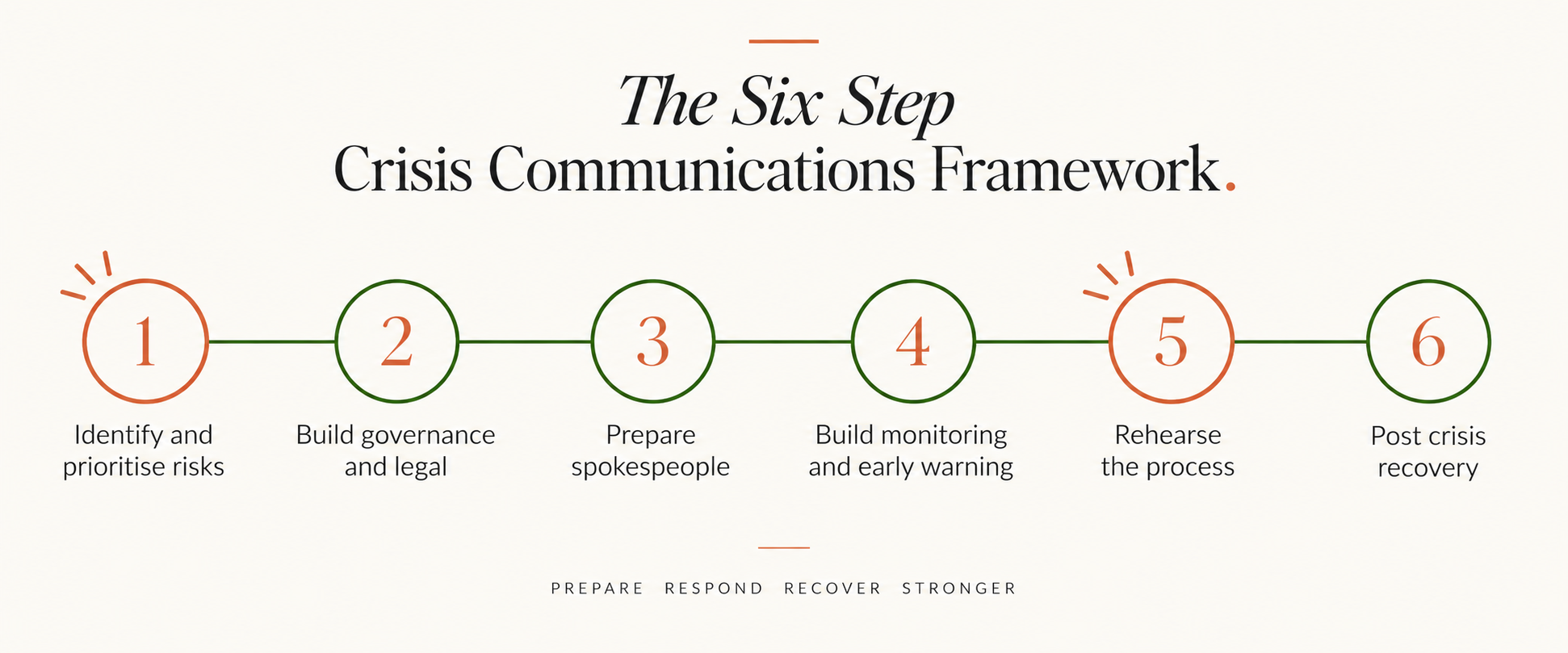
After years of building these plans in genuinely high stakes categories, I distilled the process down to six steps I now use with every client: identify and prioritise real risks, build governance and legal partnership from the start, prepare spokespeople and message frameworks in advance, build monitoring and early warning capability, rehearse the process rather than just the document, and treat post crisis recovery as its own distinct phase rather than an afterthought.
The order matters. Most organisations start at step three, drafting messaging, because it feels like the most tangible output. The plans that actually work start at step one, and take step five, rehearsal, as seriously as any of the others.
The honest truth about crisis planning
A crisis communications plan is not a document you write once and file away, hoping you never need it. It is closer to an insurance policy that only pays out if you've actually tested that the cover works. I've been in the room when the plan held, and I've seen, elsewhere, what happens when it doesn't. The difference was never the quality of the writing. It was whether anyone had actually rehearsed what was written.
If you are looking for senior communications expertise that combines strategic instinct with smart use of AI, get in touch to discuss how I work.
