
Content Marketing Strategy

Freelance Content Marketing Consultant: content built to earn attention
I'm Robbie Centellas, a freelance content marketing consultant based in London. I build content strategies that combine original research, data and expert insight to earn attention, backlinks and a place in AI search answers for consumer, health and finance brands.
I developed the strategy behind money.co.uk's business statistics page, which has earned more than 550 backlinks and been cited in a Google AI Overview, and led content work at Chemist4U that grew organic content revenue by 50% year on year.
Explore the freelance content marketing services I offer.
Why content marketing strategy needs to work harder than ever
Content marketing has always promised the same thing: build an audience by consistently publishing something genuinely useful, and that audience becomes a pipeline for trust, loyalty and eventually, commercial results. That promise still holds, but the mechanics of how content earns attention and discovery have shifted considerably, and a strategy built for how search and social worked five years ago is increasingly leaving real audience growth on the table.
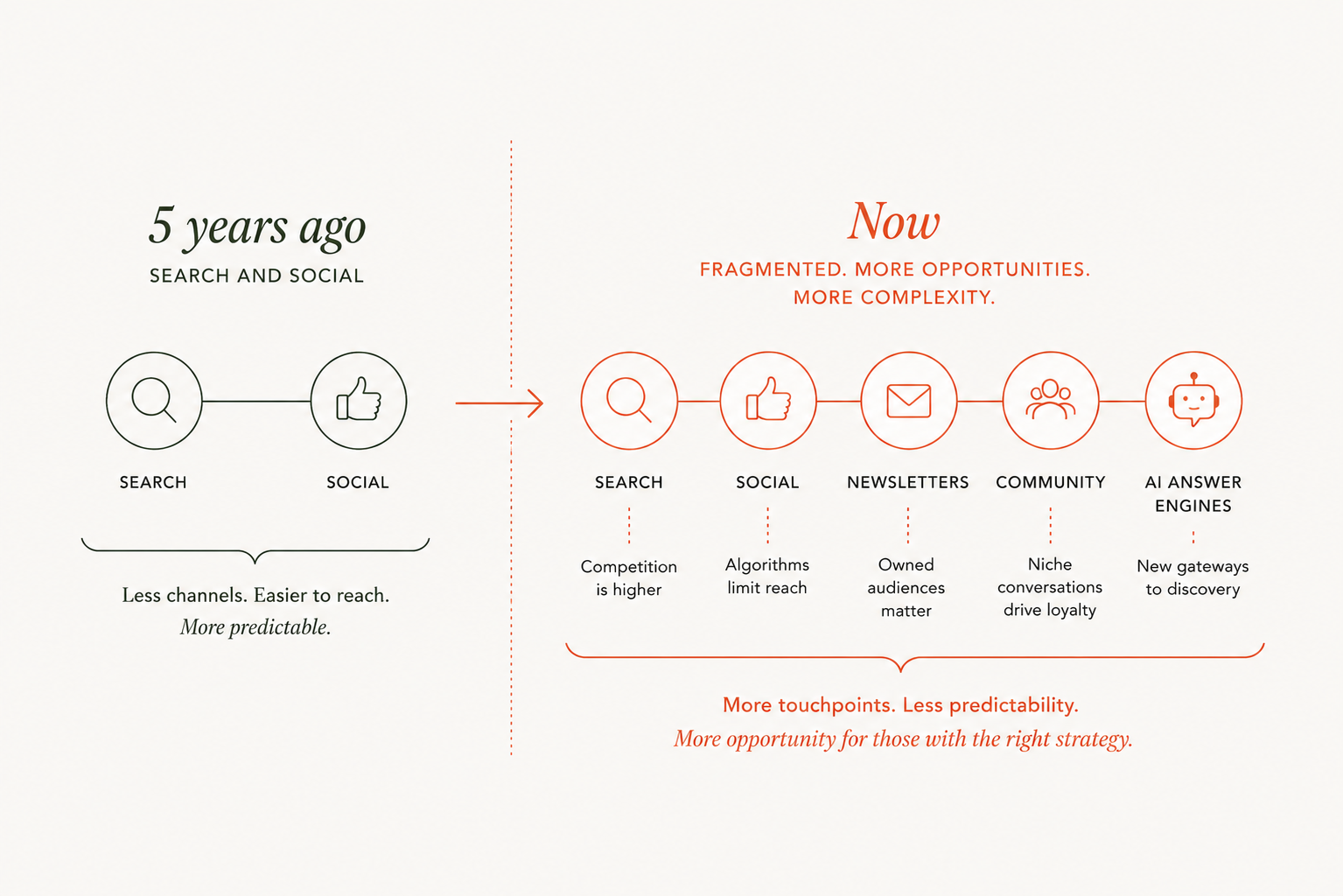
The volume of content being published has exploded, much of it AI-generated, much of it thin, repetitive and built to game rather than genuinely serve an audience. At the same time, the channels through which people discover content have multiplied and fragmented; search, social, newsletters, community platforms and now AI-powered answer engines all compete for the same attention.
A content marketing strategy built around volume alone no longer cuts through. What wins now is a strategy built around genuine differentiation, structural discoverability and a clear understanding of exactly which audiences you are trying to reach and through which channels.
I've built content marketing strategies across health, finance and consumer sectors, and the brands that win consistently are the ones treating content as a strategic asset with a clear commercial purpose, not a volume-driven content mill.
What content marketing strategy actually covers
Content marketing strategy is the discipline of planning, producing and distributing content that attracts, engages and retains a clearly defined audience, with the ultimate aim of driving profitable customer action. It sits distinct from, but closely connected to, digital PR, SEO, brand building and social media strategy, each of which is a channel or tactic content marketing draws on.
The core components of a strong content marketing strategy include
Audience and intent research, understanding exactly who you are trying to reach and what they are actually searching for or interested in at each stage of their journey
Content pillar and topic architecture, building a structured content plan around core themes rather than a disconnected list of one-off pieces
Format and channel strategy, deciding where content lives; blog, video, social, newsletter, and how it is adapted for each
Editorial production and quality control, the actual craft of writing, editing and producing content that is genuinely worth someone's time
Distribution and promotion, ensuring content reaches its intended audience rather than sitting unread on a website
Performance measurement, tracking whether content is actually achieving its commercial and audience-building objectives
AI assisted production, using AI tools to scale volume and structural tasks while human judgement governs strategy, accuracy and the pieces that carry real editorial weight
The core pillars of a content marketing strategy
Audience and intent research
Every strong content strategy starts with genuine clarity on who the content is for and what that audience actually needs at different points in their journey. This means going beyond broad demographic descriptions and understanding real search intent, the questions people are actually typing into search engines and AI tools, the problems they are trying to solve, and the format in which they prefer to consume information.
This research should map content needs across the full funnel, from someone who does not yet know they have a problem, through to someone actively comparing solutions, through to an existing customer who needs ongoing support or education. A content strategy that only serves one stage of that journey leaves significant audience growth on the table.
Content pillar and topic architecture
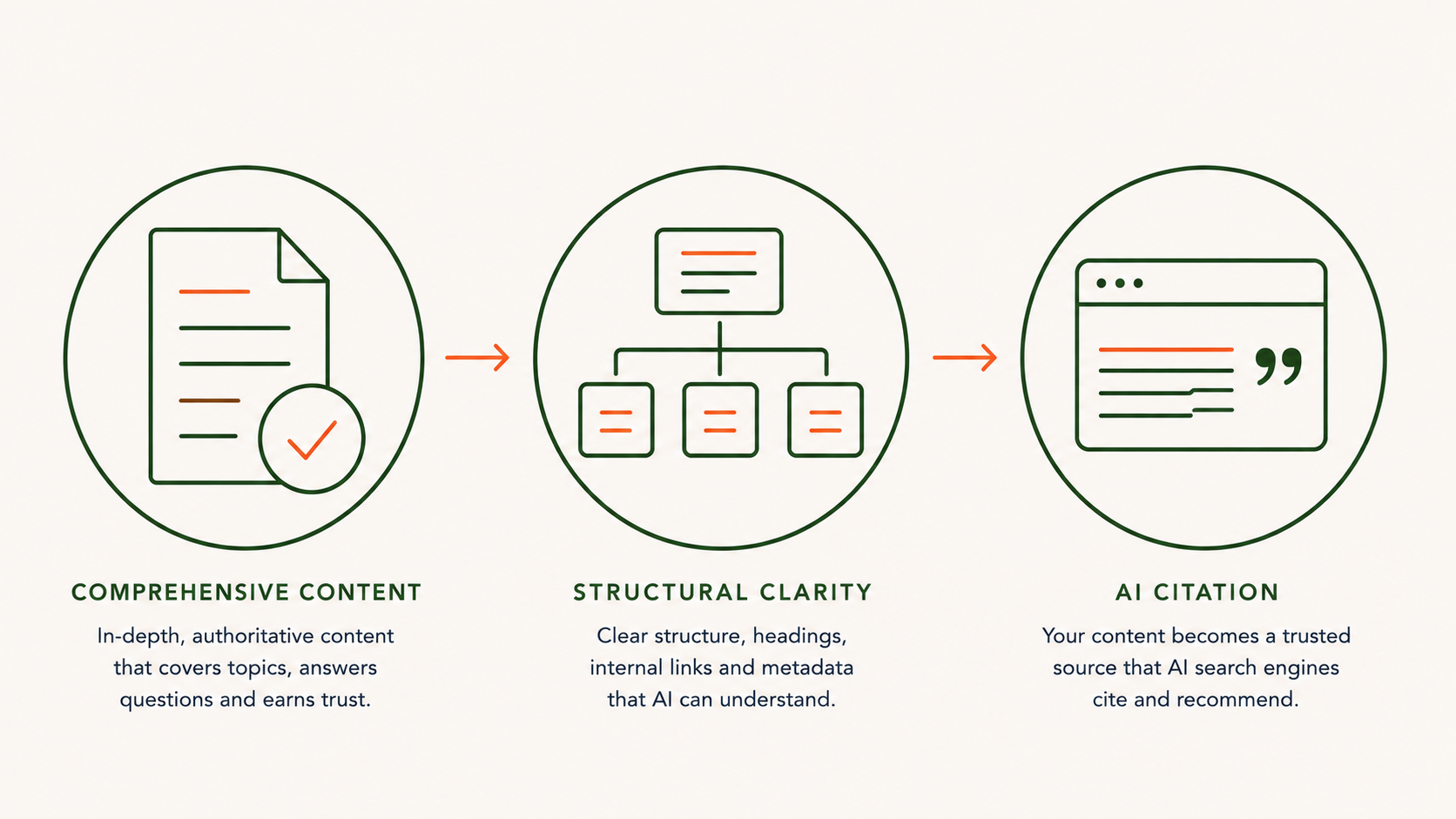
Rather than producing disconnected pieces of content reacting to whatever feels timely, a mature content strategy is built around a small number of core content pillars, comprehensive topic areas that map directly to what the audience cares about and what the business wants to be known for. Each pillar is then supported by a cluster of related, more specific content that links back to it, building topical authority over time rather than starting from zero with every new piece.
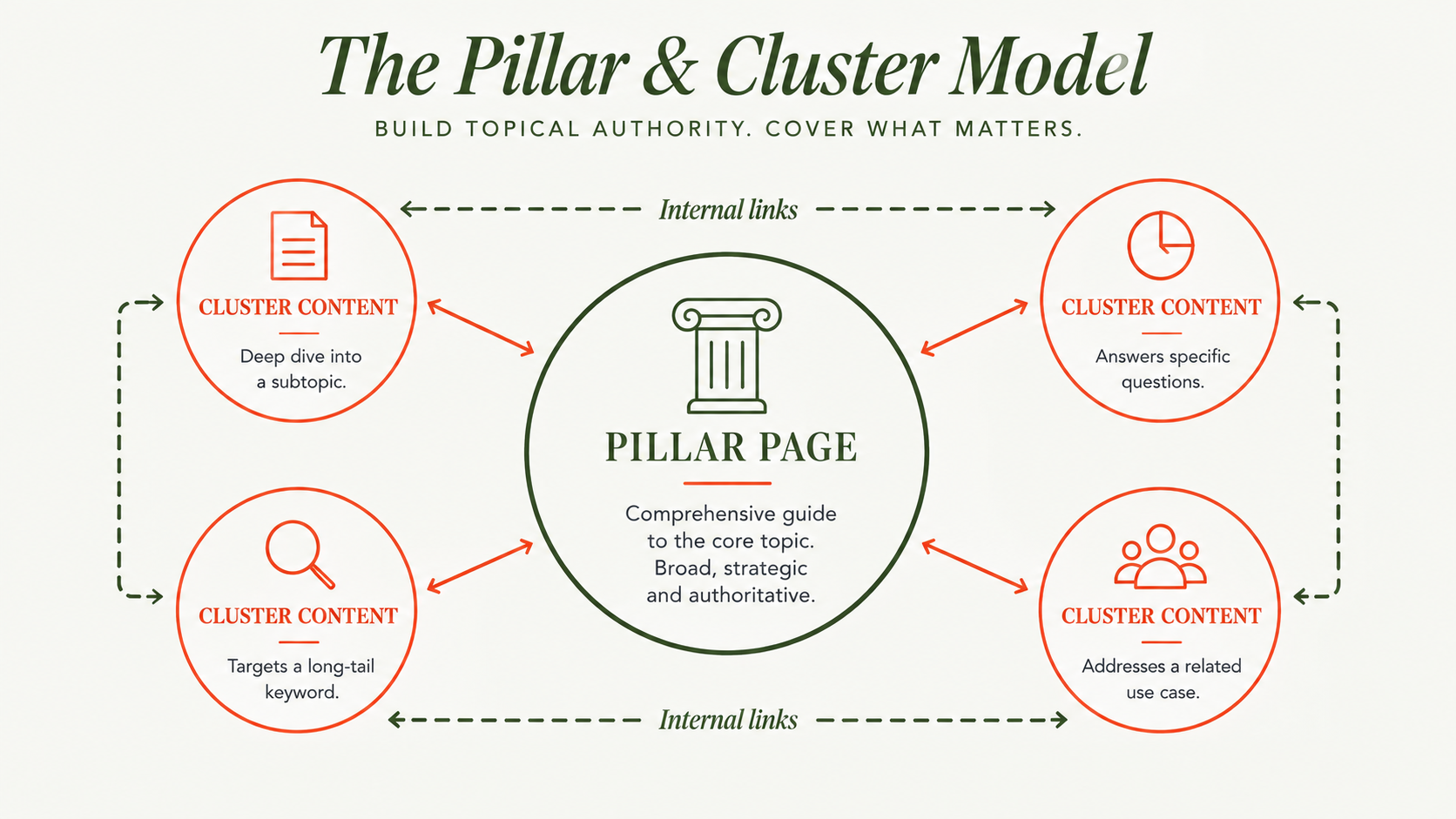
This is exactly the model behind the pillar page you are reading now, a comprehensive, authoritative piece on a core topic, designed to be the definitive resource that supporting content and internal links point back to. Done well, this structure signals genuine topical authority to both traditional search engines and AI systems evaluating which sources to trust and cite.
Format and channel strategy
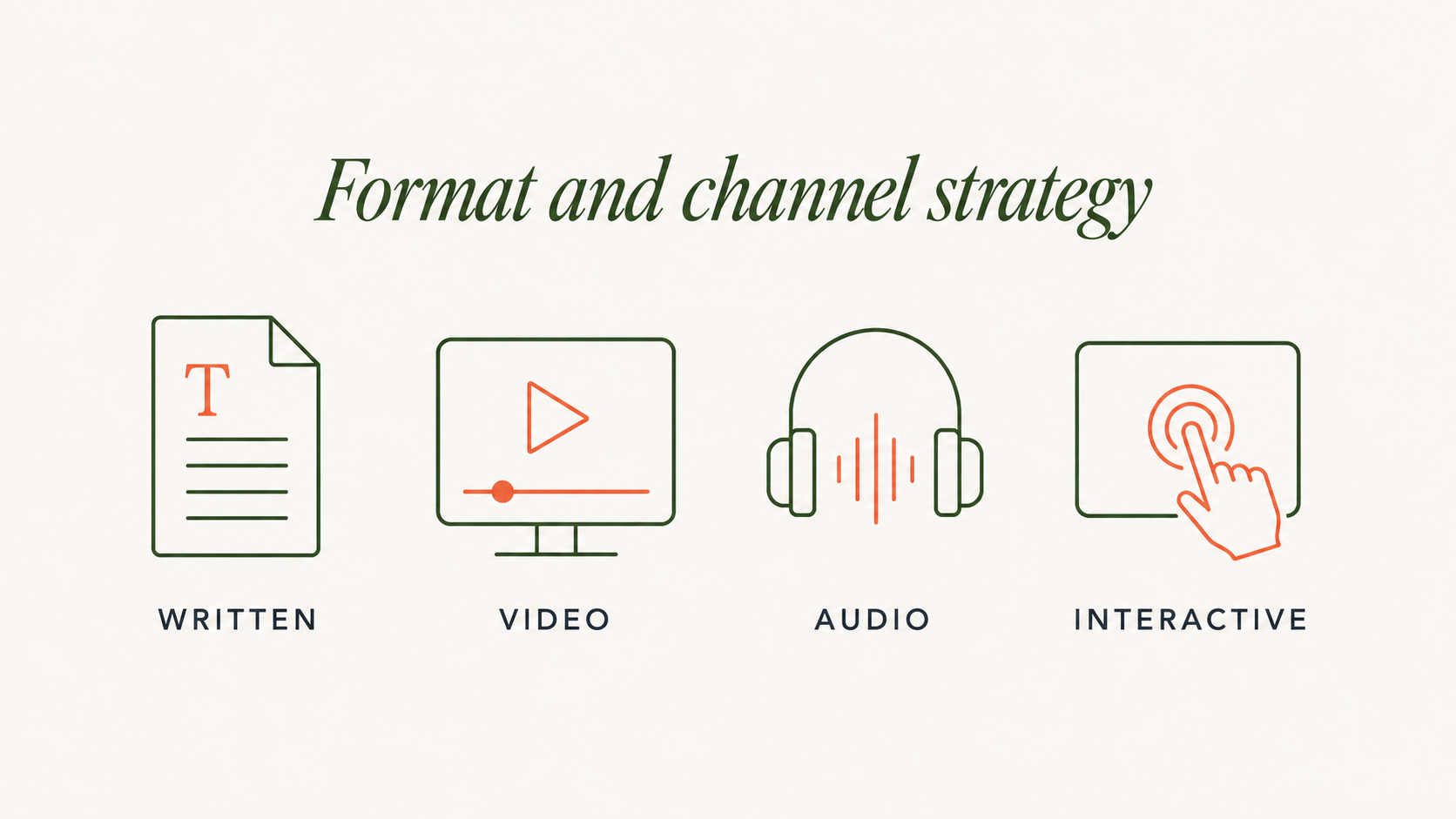
Different audiences consume content differently, and a strategy that assumes everyone wants a long-form blog post is leaving multiple audiences under-serviced. A mature content strategy deliberately maps content formats; written, video, audio, interactive tools, to the channels and audiences most likely to engage with them, and builds a repurposing workflow so that one piece of strategic thinking can be adapted efficiently across multiple formats rather than starting from scratch every time.
Editorial production and quality control
Content volume without quality control is a liability, not an asset, particularly as AI-generated content floods every channel and audiences and algorithms alike grow increasingly skilled at identifying and discounting low-value, generic output. A strong content strategy maintains genuine editorial standards, meaning original insight, accurate information, a distinctive voice and real subject matter expertise, regardless of how much of the production process is assisted by AI tools.
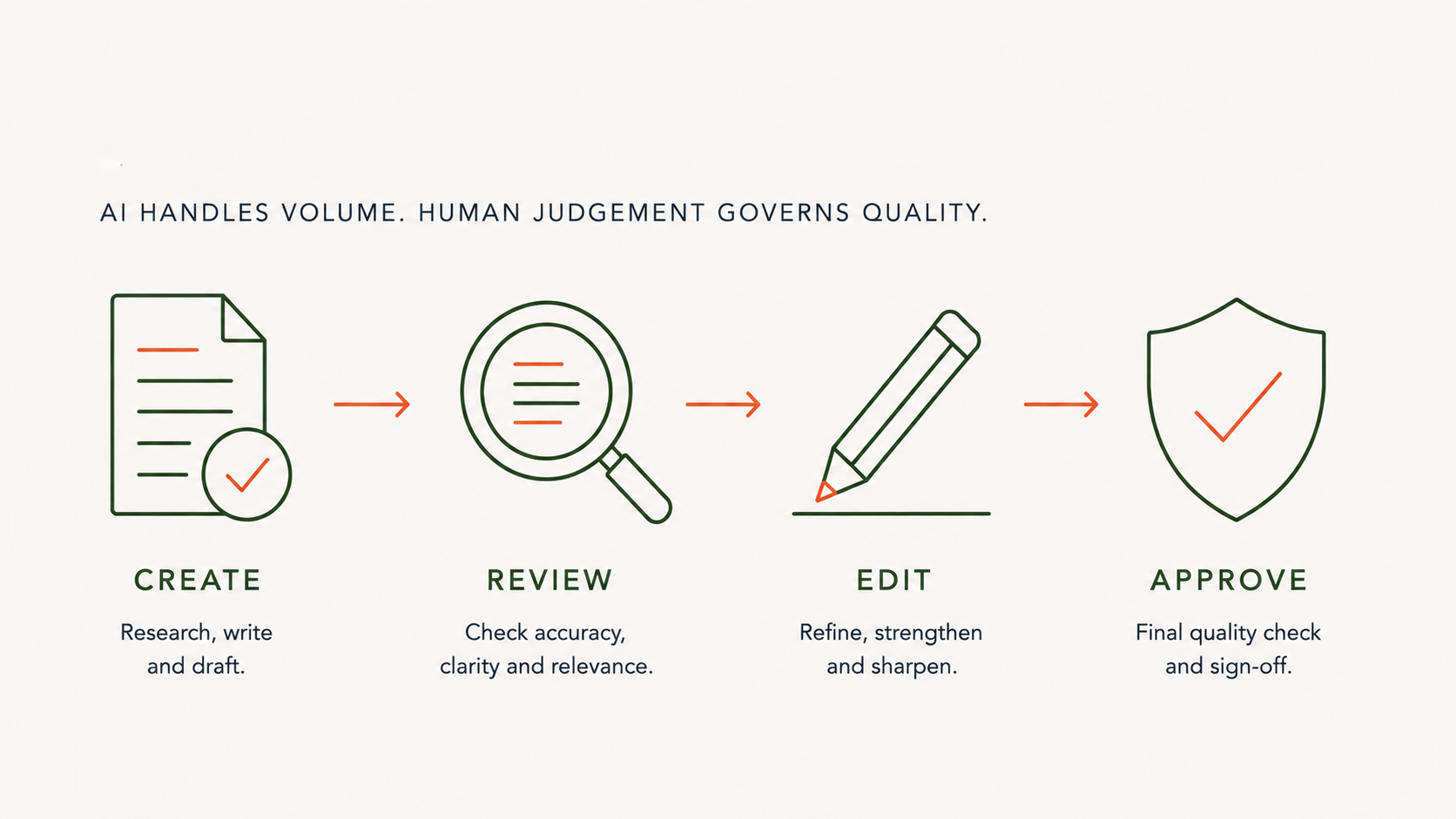
This is where I've found the sharpest divide between content strategies that build lasting audience trust and those that generate short term traffic spikes that quickly fade. AI can handle structural drafting, research synthesis and volume production extremely well. It cannot replace genuine editorial judgement about what is actually worth publishing, what is accurate in a regulated or clinical context, and what will genuinely serve the audience rather than simply fill a content calendar.
Distribution and promotion
Publishing content is only half the job. A strong distribution strategy ensures content actually reaches its intended audience, through owned channels like email and social, earned channels like digital PR and organic search, and where appropriate, paid amplification, or partnership led channels like influencer marketing, to accelerate reach for particularly strong pieces. Content strategies that underinvest in distribution consistently underperform relative to the quality of the content itself, since even excellent content struggles to build an audience if nobody finds it.
Performance measurement
Content marketing measurement should track metrics that reflect genuine audience building and commercial impact, not just traffic volume. This includes organic search visibility and ranking movement, engagement depth rather than just page views, email list growth and retention, conversion from content to commercial action, and increasingly, brand citation frequency in AI generated search results.
Content marketing strategy and AI search
Well built content only does half the job once AI tools are deciding what to cite, so this connects directly to the wider AI and GEO Strategy work I do alongside content.
Why AI search is reshaping content marketing
AI powered search tools, including Google's AI Overviews, ChatGPT search and Perplexity, are changing not just how people find content but which content gets found at all. Rather than presenting a list of links for a user to click through, these tools synthesise information from multiple sources into a single generated answer, which means content that fails to be cited or referenced in that synthesis effectively becomes invisible to a growing share of searches, regardless of how well it might otherwise rank in traditional search results.
This is a genuine shift in what content marketing needs to achieve. Traffic driven by a click through from a search results page is no longer the only, or even the primary, measure of content success. Increasingly, the goal is to become a source AI systems trust enough to cite, reference or draw language from when generating an answer, even if that specific interaction never results in a website visit at all.
Read more on how AI is changing PR and content marketing on The Spark.
How AI search opens up new audiences
Handled well, this shift is a genuine opportunity to reach audiences that traditional content marketing struggled to access. AI search tools are increasingly used for exploratory, conversational queries that would never have generated a traditional search in the first place, someone asking a detailed, specific question they would previously have needed several separate searches to answer. Content built to genuinely and comprehensively answer those specific, detailed questions, rather than content built primarily to rank for a broad keyword, has a real opportunity to reach these audiences at the exact moment they are forming an opinion or making a decision.
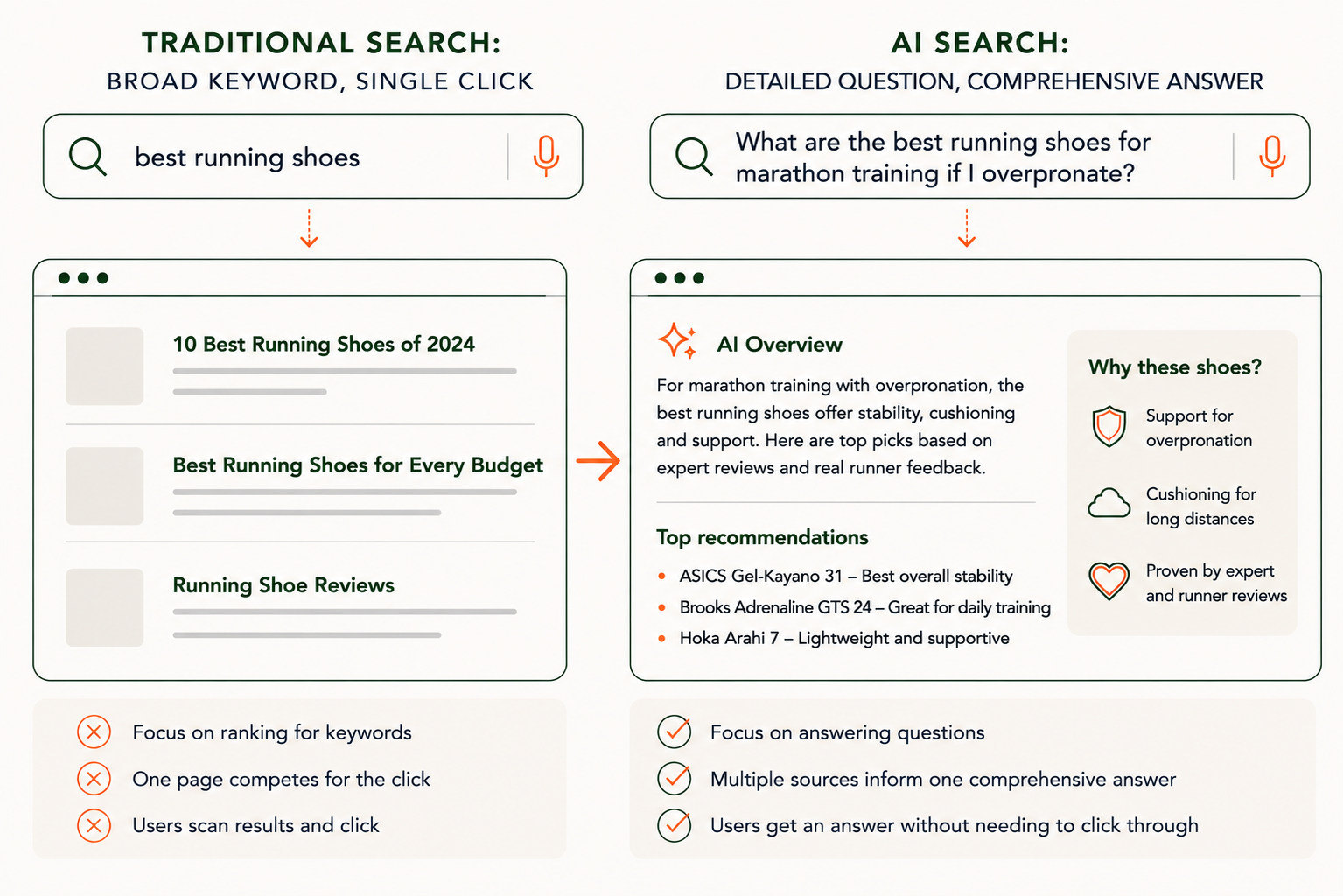
This particularly benefits content that demonstrates genuine depth and expertise rather than surface-level coverage, since AI systems appear to favour comprehensive, well-structured, clearly authoritative content when selecting what to cite or reference. A well-built pillar page structure, exactly the kind of content this page represents, is well positioned to capture this kind of AI search visibility precisely because it is built to comprehensively answer a topic rather than target a single narrow keyword.
Practical steps to optimise content marketing for AI search
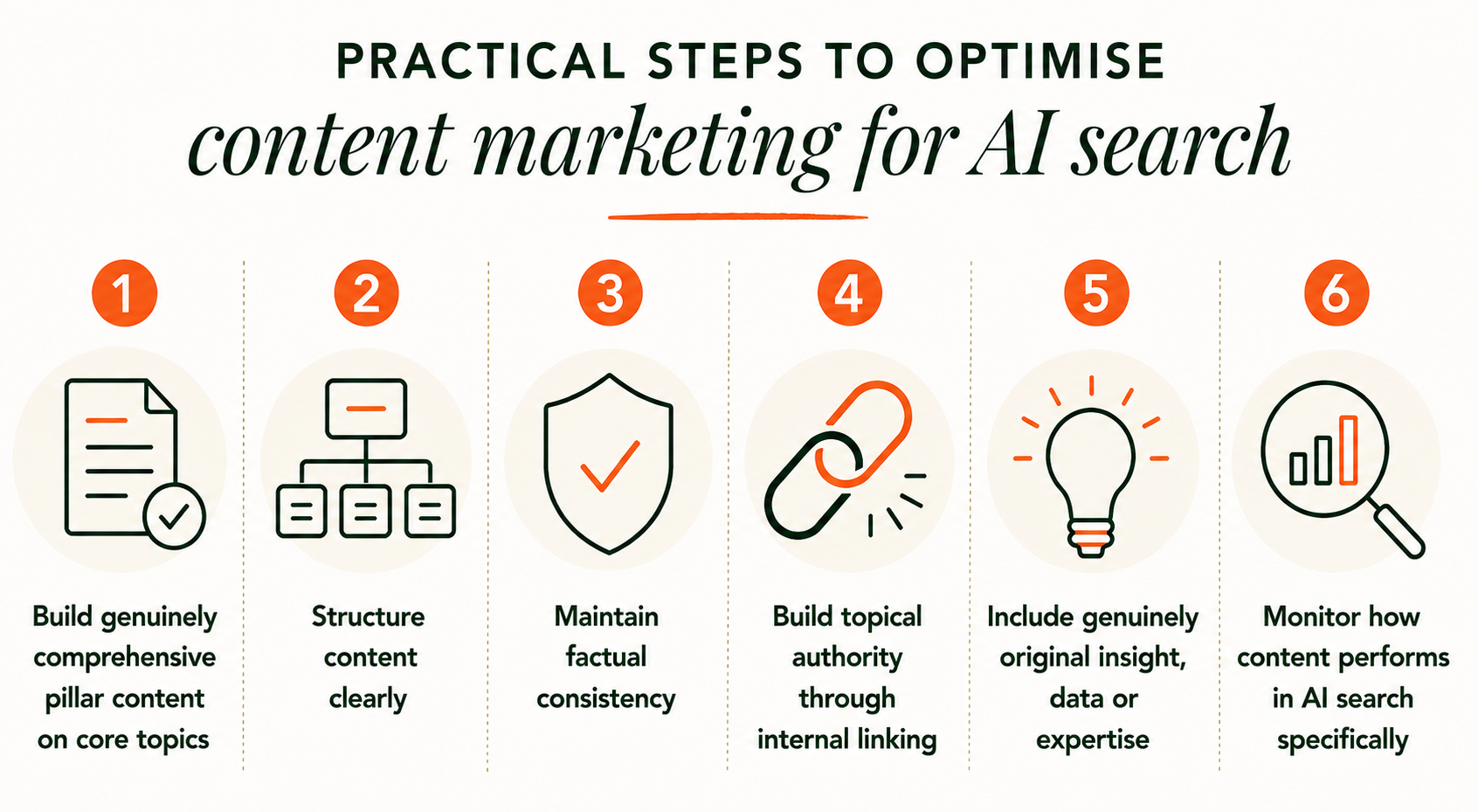
Build genuinely comprehensive pillar content on core topics, rather than thin content spread across many narrow keyword targets, since AI systems favour depth and authority over breadth of low value coverage
Structure content clearly, with descriptive headings, direct answers to specific questions and logical information hierarchy, since this structure makes content easier for AI systems to parse, extract and cite accurately
Maintain factual consistency across every piece of content on a topic, since contradictions across a site's own content undermine the authority signals AI systems look for
Build topical authority through internal linking between pillar content and supporting pieces, reinforcing which pages represent the definitive resource on a given subject
Include genuinely original insight, data or expertise wherever possible, since AI systems appear to particularly favour content that offers something not readily available elsewhere
Monitor how content performs in AI search specifically, by testing relevant queries directly, rather than relying solely on traditional search ranking and traffic metrics
The strategic opportunity
For content marketers, AI search represents both a genuine challenge to legacy traffic-driven thinking and a real opportunity to reach new, high intent audiences through a channel that rewards exactly the kind of comprehensive, well structured, genuinely expert content that a mature content strategy should already be producing. Brands that adapt their measurement and structural approach, without abandoning the fundamentals of genuine audience understanding and editorial quality, are best placed to benefit as this channel continues to grow in influence.
Building your content marketing strategy: a practical framework
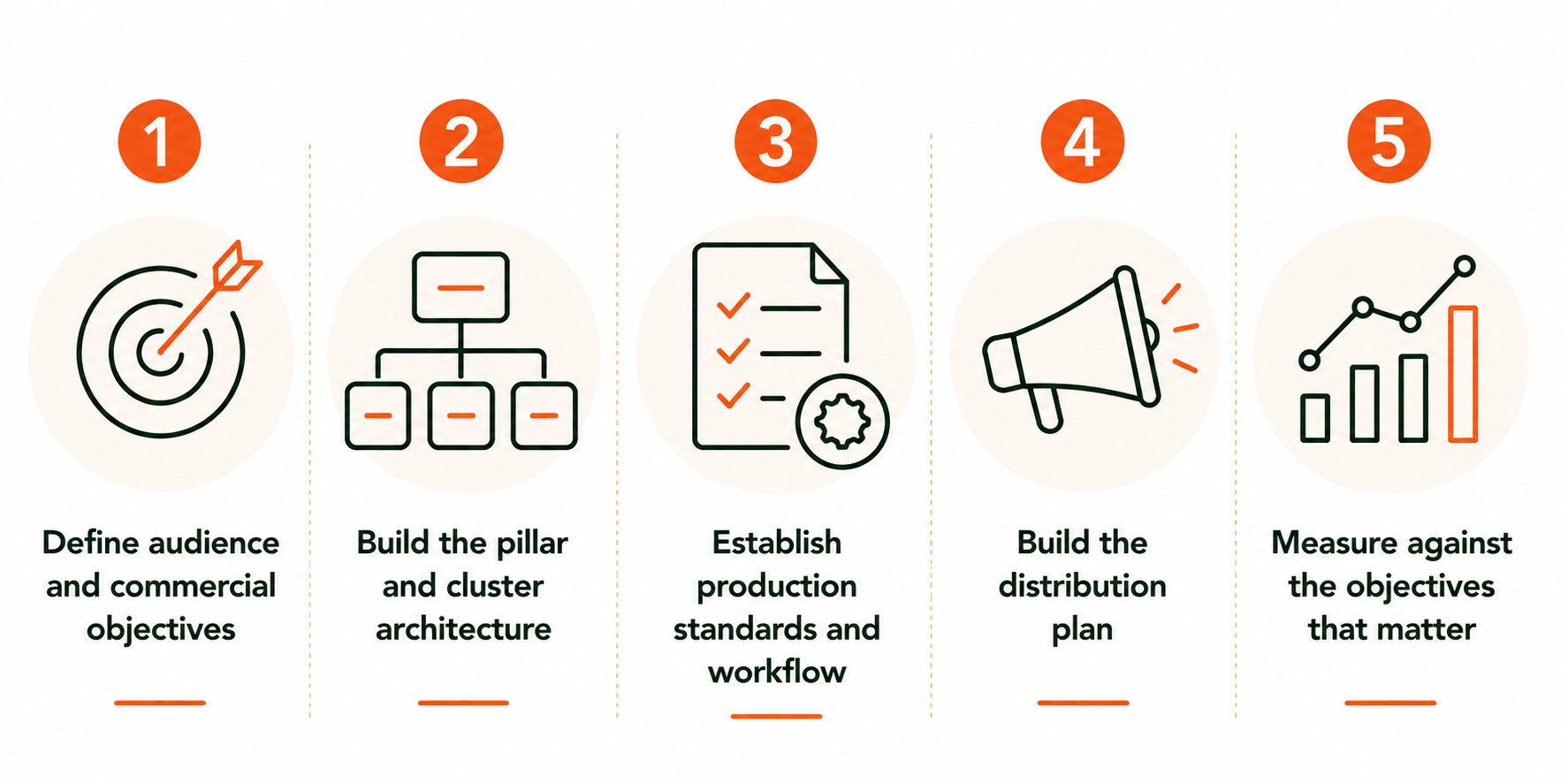
Step one: define audience and commercial objectives
Establish clearly who the content is for and what commercial or brand objective it needs to serve, avoiding the trap of producing content because it feels achievable rather than because it serves a genuine strategic purpose.
Step two: build the pillar and cluster architecture
Identify the core topics that matter most to the audience and the business, then map a structure of pillar pages and supporting cluster content around each, building genuine topical authority over time.
Step three: establish production standards and workflow
Define the editorial standards, review process and AI-assisted production workflow that will govern how content is actually made, balancing efficiency with genuine quality control.
Step four: build the distribution plan
Map exactly how each piece of content will reach its intended audience, across owned, earned and, where appropriate, paid channels, rather than treating publication as the finish line.
Step five: measure against the objectives that matter
Track performance against the audience building and commercial objectives defined in step one, including AI search visibility, rather than defaulting to vanity metrics like raw traffic or publishing volume.
Common pitfalls in content marketing strategy
The most common failure point is producing content volume without genuine strategic architecture behind it, resulting in a large but disconnected body of work that fails to build topical authority anywhere. Other recurring issues include underinvesting in distribution relative to production, treating AI-assisted production as a replacement for editorial judgement rather than a tool that still requires it, measuring success through traffic alone rather than genuine audience and commercial impact, and failing to maintain factual and stylistic consistency across content as production scales, which undermines both audience trust and AI search authority signals.
Read more about how to integrate, content, PR and social media on The Spark.
How this comes together in practice
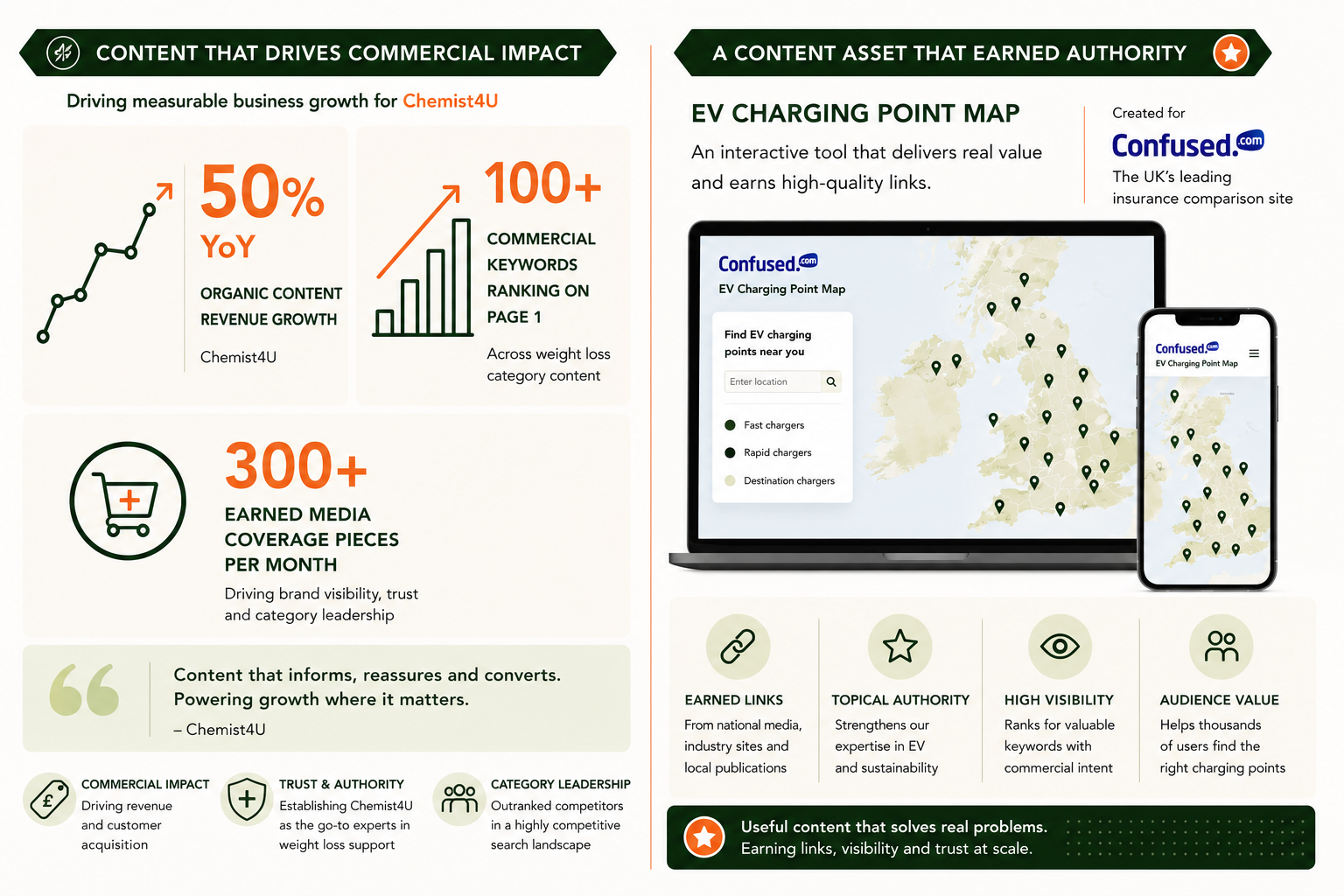
I've built and led content strategies across Chemist4U and RVU's portfolio of brands, including Uswitch, Confused.com and money.co.uk, growing organic content revenue by fifty per cent year on year at Chemist4U, the influencer led growth behind myBMI.ie and building interactive tools and stats pages at Confused.com, including the EV charging point map, that earned organic authority and national press backlinks well beyond what standard product content could achieve. That work has consistently combined genuine audience understanding with disciplined editorial production, including navigating AI-assisted content workflows in clinically sensitive contexts, where accuracy and human oversight are non-negotiable regardless of production efficiency gains elsewhere.
Content marketing strategy has always rewarded genuine expertise, structural clarity and real audience understanding over volume for its own sake. AI search is simply the latest, and in some ways the clearest, validation of that principle yet.
Great work starts with a spark. Discover the Spark at www.robbiecentellas.com.

About the author
Robbie Centellas is a senior marketing and communications consultant with almost two decades of experience across PR, digital PR, content, corporate communications and crisis communications. His work includes leading a digital PR programme at RVU delivering 25,000+ pieces of coverage and 16,000+ high-authority backlinks, and developing the Eat Less Move More campaign with Amy Tapper and Fat Tony. Read more about Robbie.
Content Marketing Strategy FAQs
-
Content marketing strategy is a structured, audience led plan built around clear commercial and brand objectives, not a content calendar filled with whatever feels timely. The difference between strategy and simply publishing is intent, every piece should map to a specific audience need and a specific stage of their journey, rather than existing because a schedule needed filling.
-
A pillar page is a comprehensive, authoritative piece covering a core topic in full, like this page. Cluster content is a set of more specific, related pieces that link back to that pillar, building topical authority over time. Search engines and AI systems increasingly reward this structure because it signals genuine depth on a subject rather than scattered, disconnected coverage.
-
Genuine audience needs, with SEO as a lens applied afterward rather than the starting point. Content built purely to target a keyword tends to read as hollow and underperforms with both readers and increasingly, AI systems evaluating which sources genuinely answer a question well. Content built to genuinely serve a real audience need, then structured well for discoverability, consistently performs better over time.
-
AI can handle a significant share of structural drafting, research synthesis and volume production effectively. What it cannot replace is editorial judgement, deciding what is actually worth publishing, verifying accuracy in regulated or clinical contexts, and maintaining a distinctive voice and genuine expertise. The strongest content strategies use AI to scale efficiently while keeping human oversight on anything that carries real editorial or reputational weight.
-
AI search tools favour comprehensive, well structured, clearly authoritative content when deciding what to cite or reference. This means the fundamentals of good content strategy, genuine depth, clear structure and real expertise, translate directly into AI search visibility, often more reliably than tactics built purely around traditional keyword ranking.
-
I track organic search visibility and ranking movement, engagement depth rather than raw page views, email list growth and retention, conversion from content to commercial action, and increasingly, how often a brand is cited or referenced in AI generated answers. Traffic volume alone is rarely a meaningful measure on its own.