
Corporate Communications Strategy

Freelance Corporate Communications Consultant: consistent messaging that builds trust
I'm Robbie Centellas, a freelance corporate communications consultant based in London. I help organisations build clear, consistent messaging across leadership, stakeholders and the media, so a business is understood the same way everywhere it's discussed.
I've worked with Novo Nordisk's Director of Obesity and clinical team on communications accuracy in a heavily regulated category, and led stakeholder communications through the UK energy crisis while at Uswitch, across regulatory, media and consumer audiences.
Explore the freelance corporate communications services I offer.
Why corporate communications strategy matters now more than ever
Corporate communications sits at the centre of how an organisation is understood, trusted and judged, not just by customers but by investors, regulators, employees, partners and increasingly, by AI systems that now shape how information about a company is discovered and summarised. It is the discipline responsible for controlling the narrative around who a business is, what it stands for and how it behaves when things go well and when they do not.
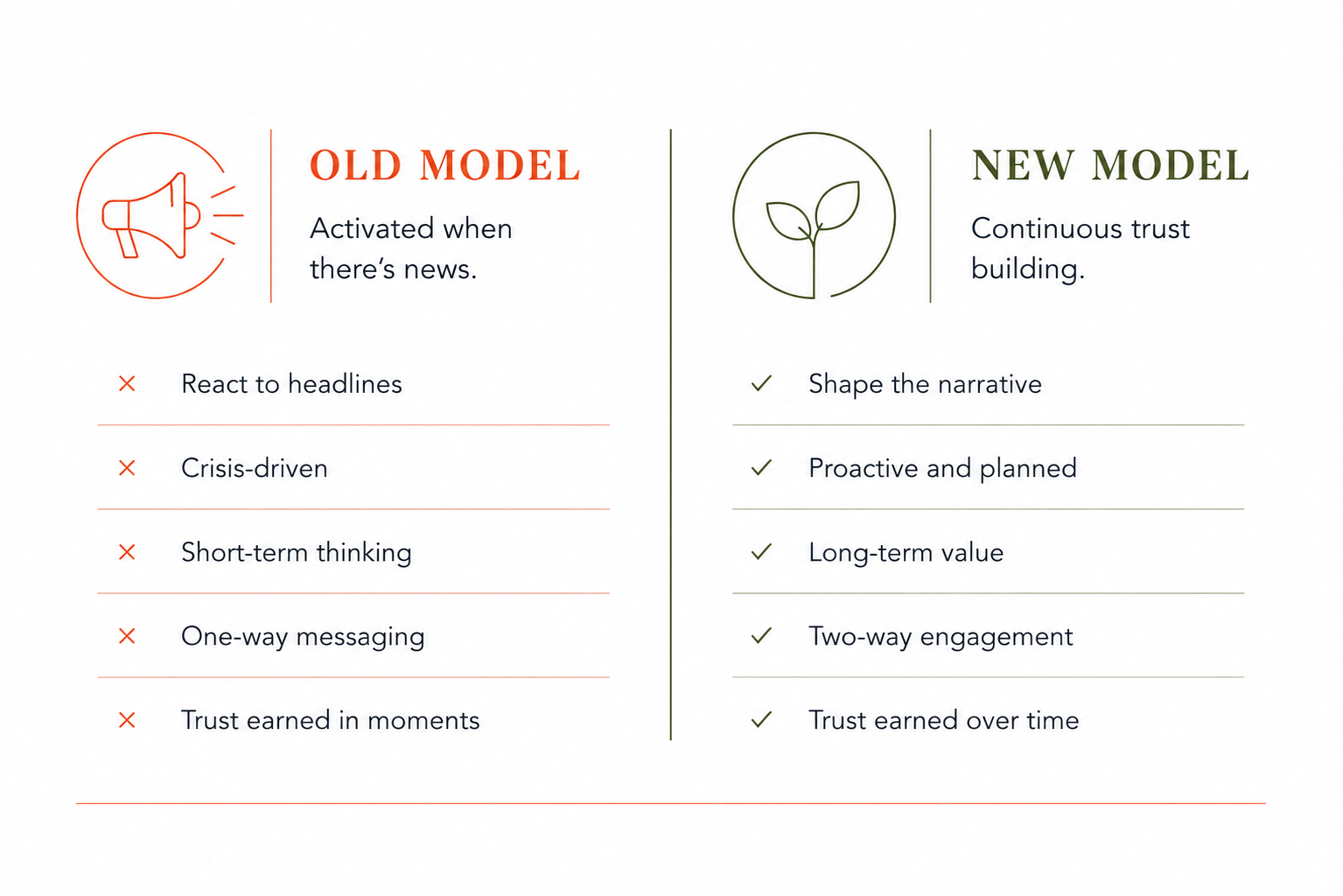
For years, corporate communications was treated as a support function, sitting behind marketing and sales, activated mainly when there was news to announce or a problem to manage. That model no longer holds. In a world where a single leaked document, regulatory filing or executive comment can be summarised by an AI search tool within hours and served to millions of people as fact, corporate communications has become a frontline commercial function. It protects share price, it protects talent retention, it protects regulatory relationships and it protects the licence to operate.
A strong corporate communications strategy is not reactive. It is a proactive, structured approach to building trust and authority over time, so that when a difficult moment arrives, the organisation has a reservoir of credibility to draw on rather than starting from zero.
What corporate communications actually covers
Corporate communications is often confused with PR or marketing communications, but it operates at a different altitude. Where marketing communications is focused on driving demand for products and services, corporate communications is focused on protecting and building the reputation of the organisation itself, across every audience that has a stake in its success.
The core areas of responsibility typically include:
Executive and leadership communications, including positioning senior spokespeople as credible, visible voices
Investor and financial communications, ensuring consistent, accurate messaging around performance and strategy
Employee communications, building internal trust and alignment, particularly during periods of change
Regulatory and government relations communications, managing relationships with bodies that hold licensing or oversight power
Reputation management, including proactive narrative building and issues monitoring
Crisis and issues communications, though this is significant enough to warrant its own dedicated strategy
Corporate social responsibility and ESG communications, demonstrating credible action rather than performative statements
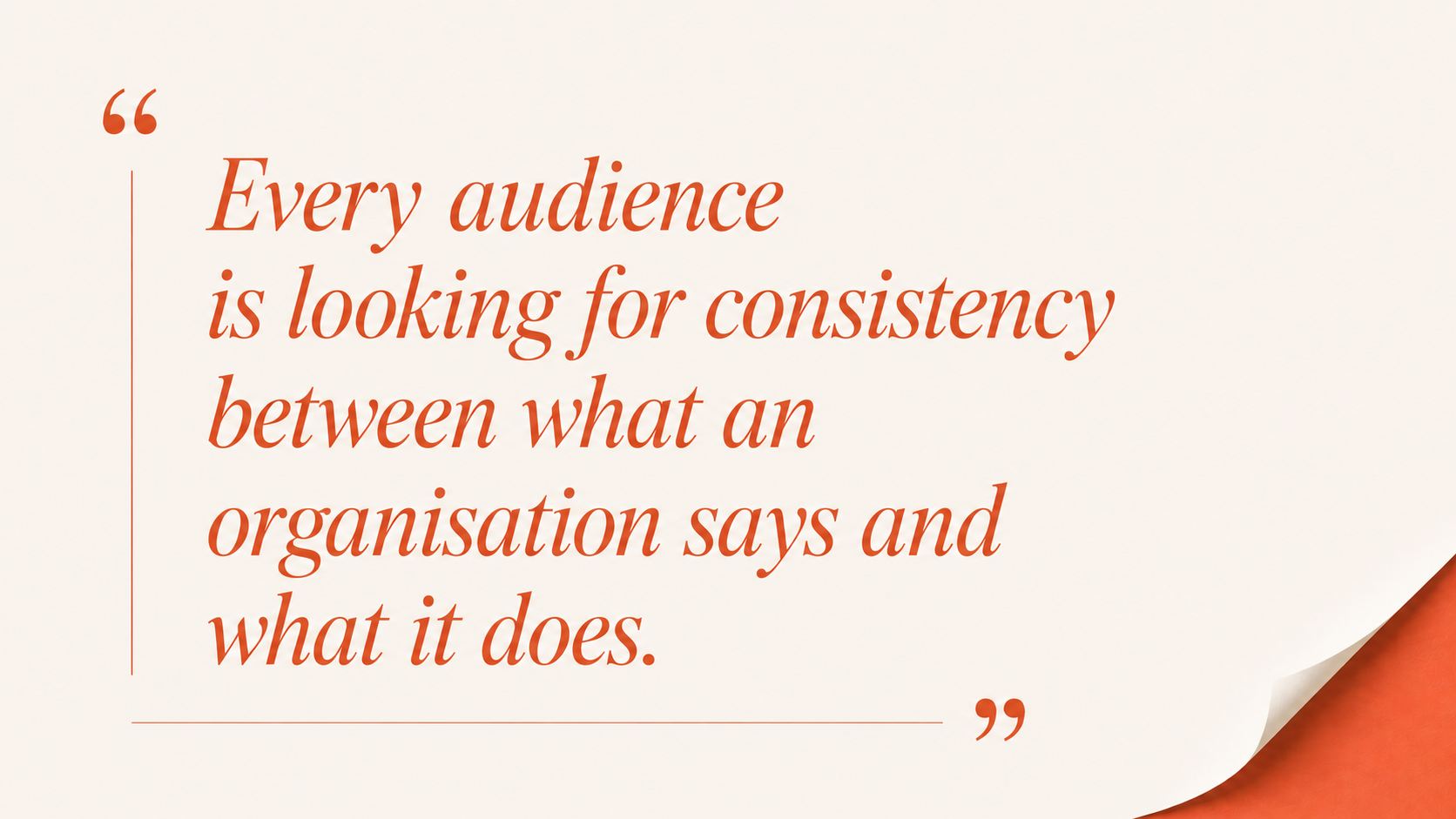
What unites all of these areas is a single underlying principle. Every audience, whether an investor, an employee, a journalist or an AI system summarising your company's news coverage, is looking for consistency between what an organisation says and what it does. Corporate communications strategy exists to make sure that consistency is real, and that it is communicated clearly to every audience that needs to see it.
The core pillars of a corporate communications strategy
Message architecture and narrative consistency
Every credible corporate communications strategy starts with a clear message architecture, a defined set of core narratives about who the organisation is, what it stands for and where it is heading, that every spokesperson, every piece of content and every public statement draws from. Without this, an organisation ends up with fragmented messaging, different executives describing the same strategy in different ways, different regions telling different stories, and a public narrative that feels inconsistent or untrustworthy.
Building message architecture requires genuine collaboration across the business, not just the communications function. It means sitting with leadership to understand strategic priorities, sitting with legal and compliance to understand constraints, and sitting with commercial teams to understand what language actually resonates with customers and stakeholders.
Executive positioning and spokesperson development
An organisation's reputation is disproportionately shaped by how its leaders show up publicly. A well-prepared, credible chief executive or senior spokesperson can build trust faster than any amount of paid or owned content, while an unprepared or inconsistent one can undo years of careful reputation building in a single interview.
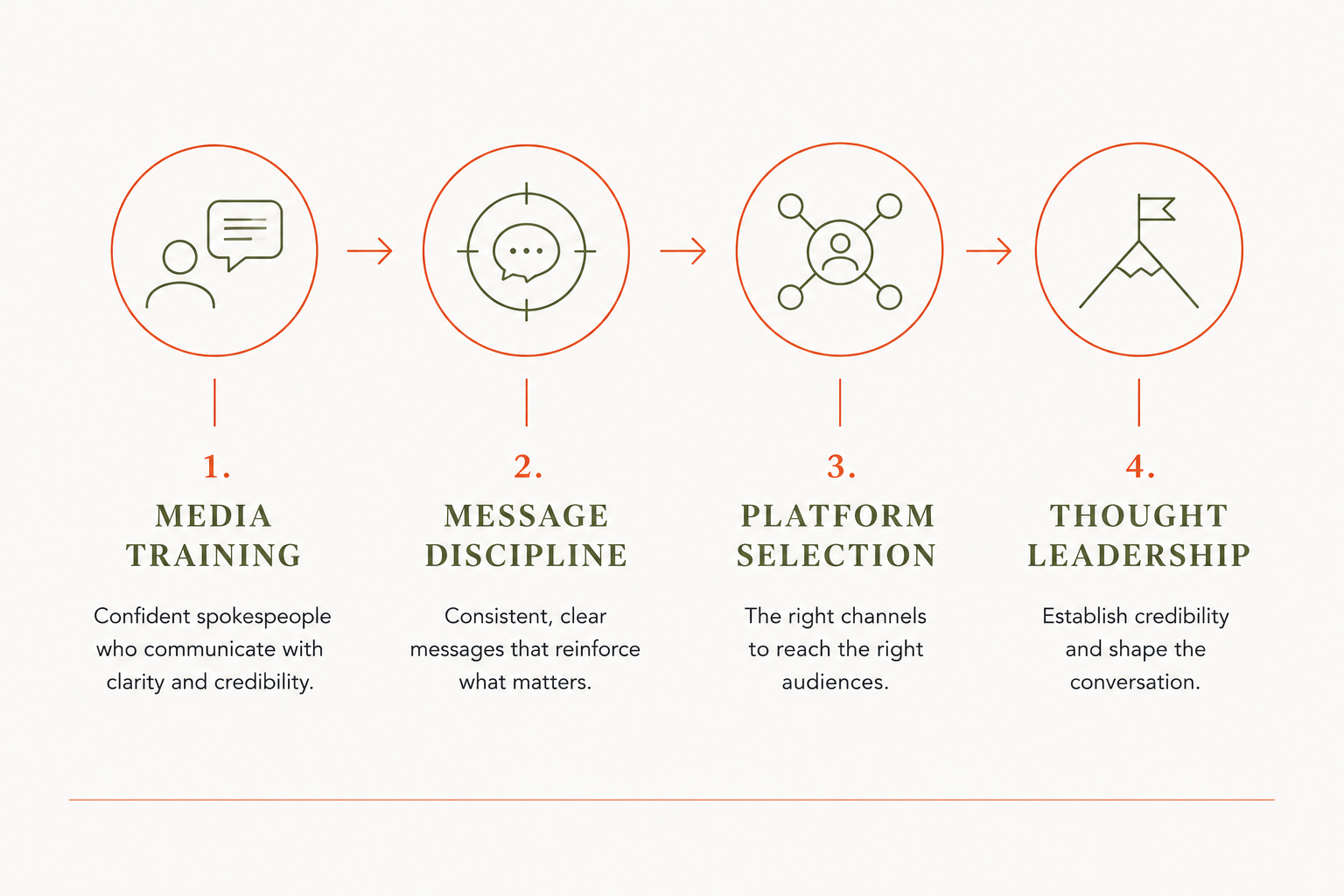
Executive positioning work includes media training, message discipline coaching, identifying the right platforms and opportunities for visibility, and building an established thought leadership presence that positions leadership as genuinely credible voices in their sector rather than simply mouthpieces for corporate messaging.
Stakeholder mapping and audience-specific strategy
Corporate communications is unusual in that it must speak convincingly to audiences with genuinely different, sometimes competing, priorities. Investors want confidence in financial performance and strategic direction. Employees want honesty and clarity, particularly during periods of uncertainty. Regulators want demonstrable compliance and good faith engagement. Journalists want a story that is newsworthy and factually solid.
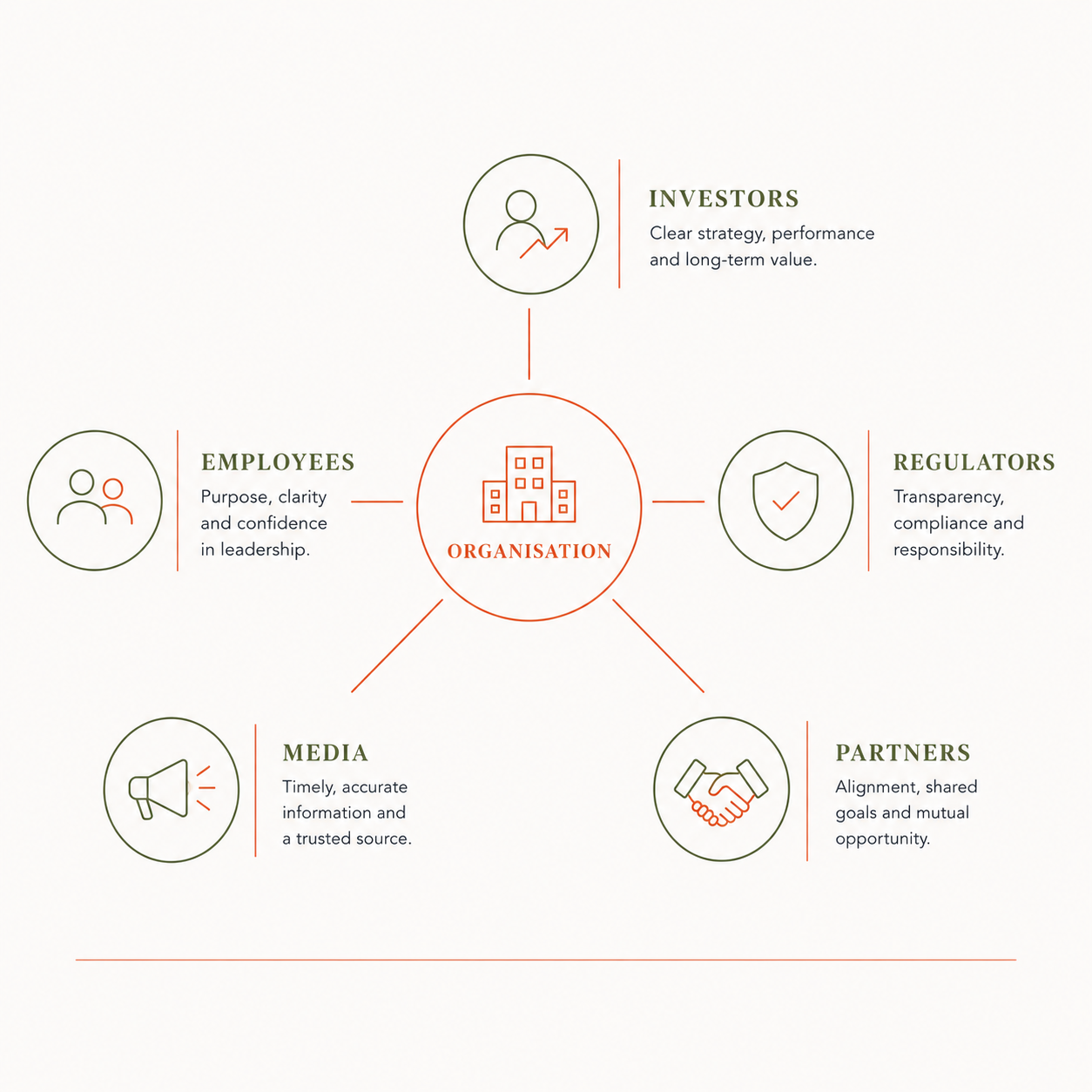
A mature corporate communications strategy maps these stakeholder groups explicitly and builds tailored messaging, channels and cadence for each, while ensuring the underlying narrative remains consistent across all of them. Inconsistency between what investors are told and what employees are told, for instance, is one of the fastest ways to destroy internal and external trust simultaneously.
Proactive reputation building
The strongest corporate communications strategies do not wait for news to happen; they create it. This means building a consistent drumbeat of proactive announcements, thought leadership, data driven insight and credible third-party validation that shapes the narrative before external events or competitors do it instead.
This proactive layer is also what builds the reservoir of trust an organisation draws on during a crisis. A company that has spent years being transparent, responsive and genuinely engaged with its stakeholders earns the benefit of the doubt when something goes wrong. A company that has been silent or evasive does not.
Internal and change communications
Employees are one of the most influential, and most overlooked, audiences in corporate communications. They talk to friends, family and their own networks about what it is really like inside an organisation, and in an era of platforms like Glassdoor and LinkedIn, that internal sentiment becomes public reputation extremely quickly.
Effective internal communications requires the same rigour as external communications, clear message architecture, consistent cadence, genuine two-way engagement rather than top-down broadcast, and particular care during periods of organisational change such as restructuring, leadership transitions or mergers, when uncertainty is highest, and misinformation spreads fastest.
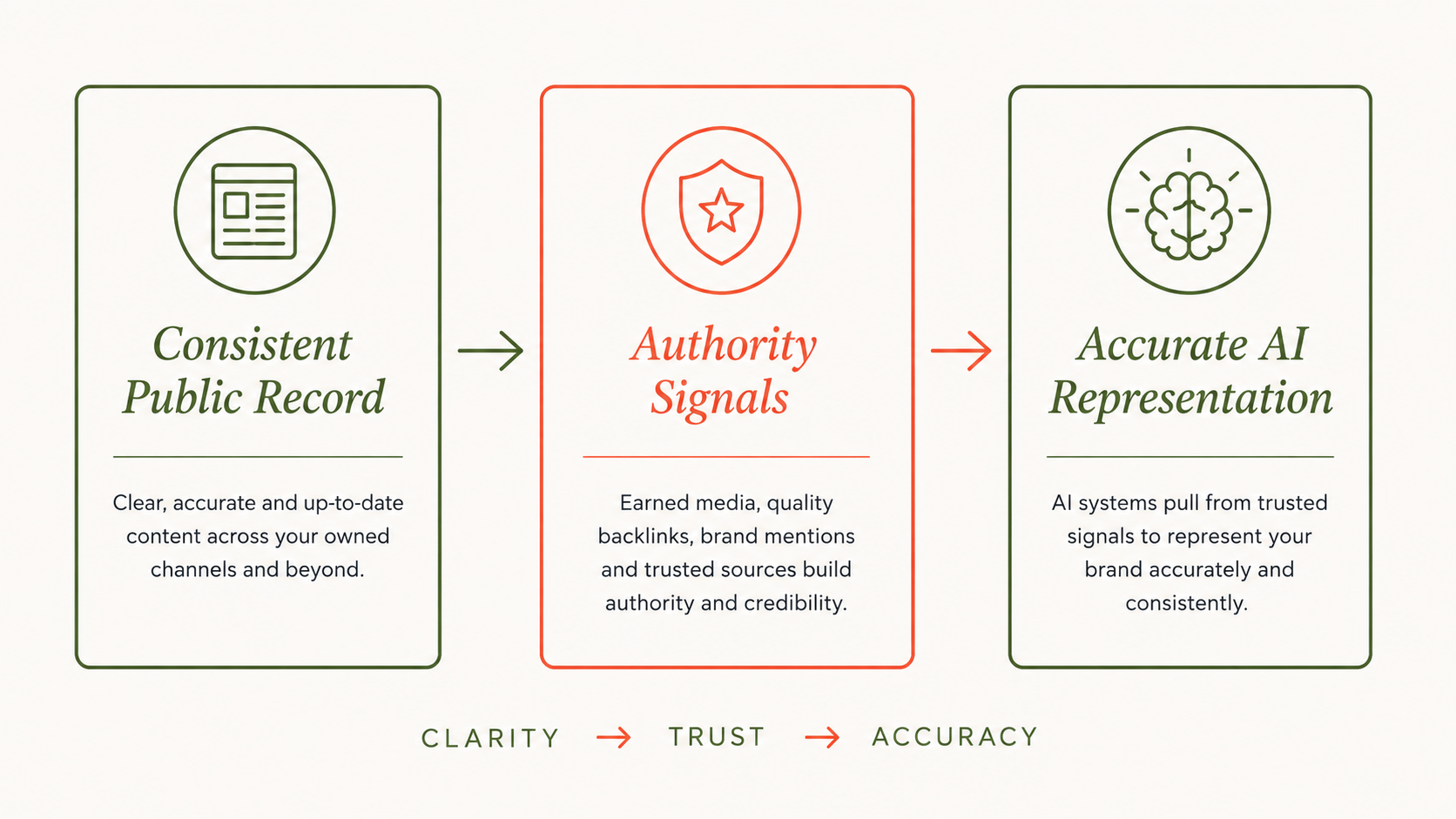
Corporate communications and AI search
A consistent, well told corporate story gives AI tools a clear entity to recognise, which is exactly what I cover in more depth in my AI and GEO Strategy.
Why AI search is now a best practice consideration for corporate communications
The rise of AI-powered search and answer engines, including Google's AI Overviews, ChatGPT search, Perplexity and similar tools, has introduced a new and largely under-considered dimension to corporate communications strategy. When a prospective investor, a journalist researching a story, a potential employee or a business partner searches for information about your organisation, there is now a meaningful chance they receive an AI-generated summary rather than a list of links to review themselves.
This matters enormously for corporate communications because these AI-generated summaries are not neutral. They are built from whatever content is most consistently available, most authoritative and most frequently cited across the web. An organisation that has been proactive, transparent and consistent in its public communications is likely to be represented accurately and favourably. An organisation that has been quiet, inconsistent or has allowed outdated or negative narratives to persist unchallenged risks having that inaccurate or unflattering picture repeated, synthesised and presented as current fact to exactly the audiences corporate communications exists to influence.
The specific risks for corporate reputation
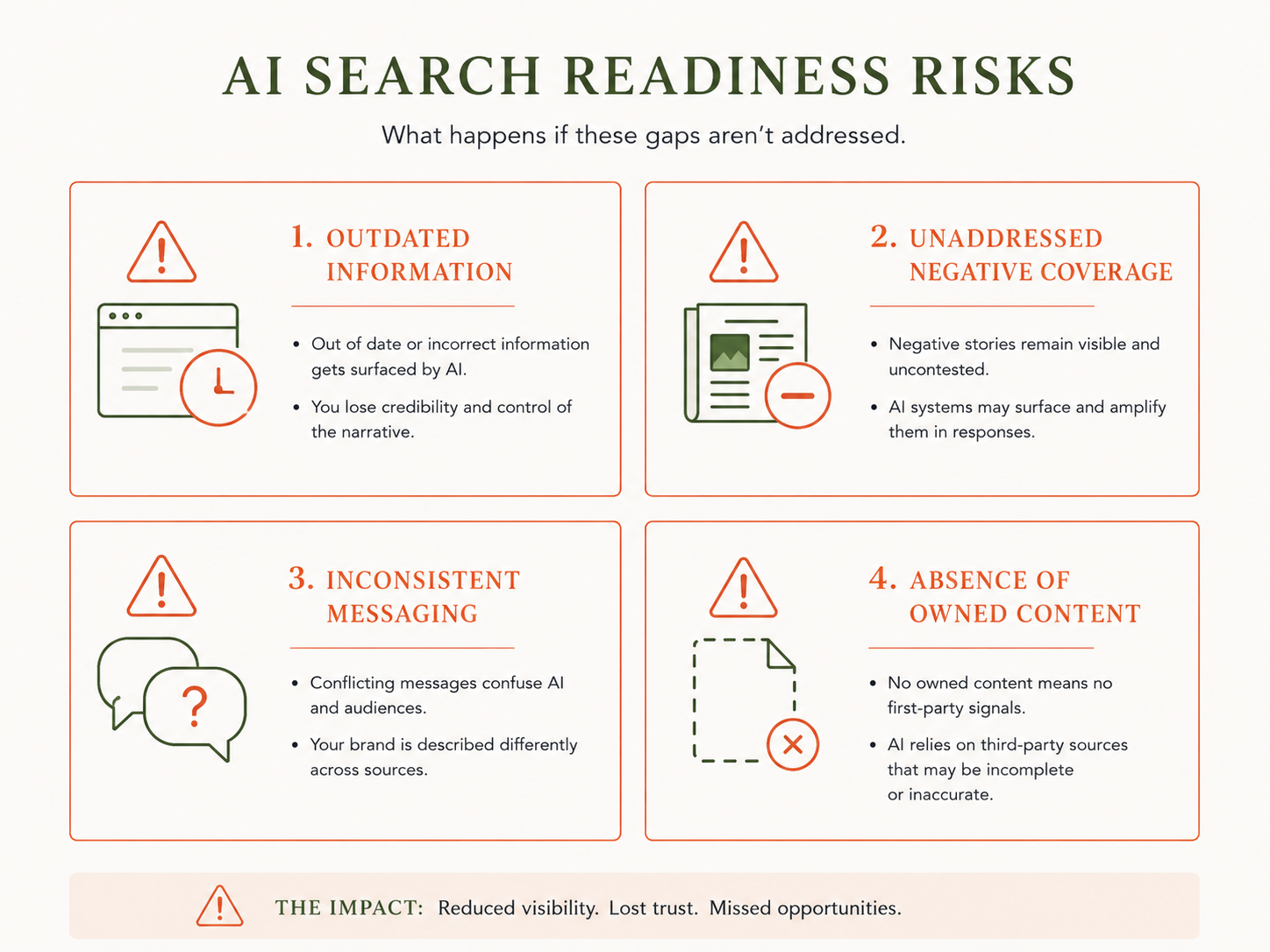
There are a handful of scenarios where this shift creates genuine exposure:
Outdated leadership information, former executives or discontinued strategies being cited as current because no updated, authoritative content exists to correct the record
Unaddressed negative coverage, a single critical article from years ago being surfaced and repeated as the dominant narrative because it has not been counterbalanced by more recent, credible content
Inconsistent messaging across sources, different figures, different strategic priorities or different positioning appearing across various pieces of coverage, creating confusion in any AI generated summary that tries to synthesise them
Absence of authoritative owned content, meaning an organisation has left journalists and third parties as the only sources of information about it, ceding control of the narrative entirely
Best practice for AI search readiness in corporate communications
Building AI search readiness into corporate communications strategy is not a separate workstream, it is an extension of doing corporate communications well. The following practices make a measurable difference:
Maintain clear, current, well-structured information about leadership, strategy and performance on owned channels, since this becomes a primary reference point AI systems can draw from
Ensure consistency of key facts, figures and positioning across every piece of content and every spokesperson interview, since contradictions across sources actively undermine the confidence signals these systems look for
Proactively address and correct outdated or inaccurate information in the public domain rather than assuming it will fade from relevance, since AI systems can resurface older content without clear time weighting
Build a consistent cadence of credible third party coverage and expert commentary, so the organisation is represented by multiple independent, authoritative sources rather than relying solely on owned channels
Treat executive visibility and thought leadership as reputation infrastructure, since named, credible spokespeople with a consistent public record are a strong trust signal for both human audiences and AI systems
Monitor how the organisation is currently represented across major AI search tools by testing relevant queries directly, treating any inaccuracies as a communications issue to be addressed with the same urgency as traditional media inaccuracies
Reframing the opportunity
For corporate communications leaders, AI search is not a new discipline to master from scratch, it is validation of long standing best practice. Consistency, transparency, proactive narrative building and genuine stakeholder engagement have always been the foundations of strong corporate reputation. What has changed is the speed and scale at which gaps in that foundation are now exposed, and the breadth of audiences that can be affected by a single inaccurate or outdated AI generated summary.
Organisations that treat this as a reason to double down on communications fundamentals, rather than chase a specific technical fix, will be the ones best positioned as this shift continues.
Building a corporate communications strategy: a practical framework
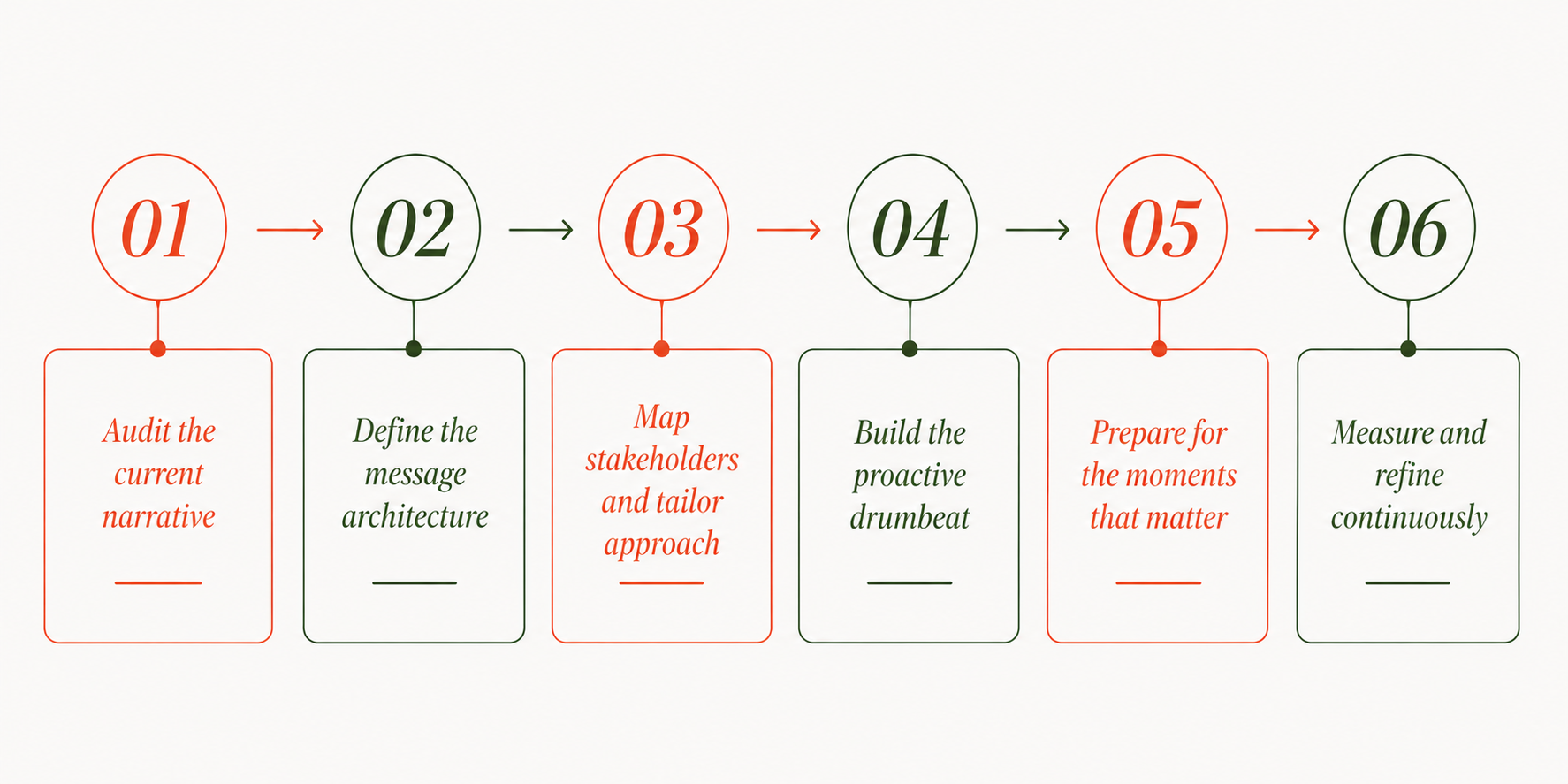
Step one: audit the current narrative
Before building anything new, understand how the organisation is currently perceived and represented, across traditional media, social platforms, employee sentiment channels and AI search tools. This audit reveals the gaps a new strategy needs to close.
Step two: define the message architecture
Build the core narratives that every communication will draw from, developed in genuine collaboration with leadership, legal and commercial stakeholders, not written in isolation by the communications function.
Step three: map stakeholders and tailor approach
Identify every audience with a stake in the organisation's reputation and define the specific messaging, channels and cadence needed to reach and build trust with each, while protecting overall narrative consistency.
Step four: build the proactive drumbeat
Establish a consistent cadence of proactive communications, thought leadership, data-led insight and credible third-party coverage, rather than relying on reactive announcements alone.
Step five: prepare for the moments that matter
Build the governance, protocols and spokesperson readiness needed for high-stakes moments, whether that is a product launch, a leadership transition or a genuine crisis, so the organisation is never starting its response from a standing start.
Step six: measure and refine continuously
Track sentiment, share of voice, message consistency and now AI search representation on an ongoing basis, treating corporate communications strategy as a living function rather than a document that is written once and filed away.
Common pitfalls in corporate communications strategy
The most common failure point in corporate communications is treating it as a reactive, announcement-driven function rather than a proactive discipline built on consistent narrative and genuine stakeholder trust. Other recurring issues include allowing message architecture to fragment across regions or business units, under investing in executive media training until a crisis makes the gap painfully visible, focusing communications effort almost entirely on external audiences while neglecting the employee base whose sentiment shapes public reputation just as powerfully, and failing to correct outdated or inaccurate public information because it feels like a low priority task until it resurfaces at the worst possible moment, often through an AI generated summary that a key stakeholder happens to read.
How this comes together in practice
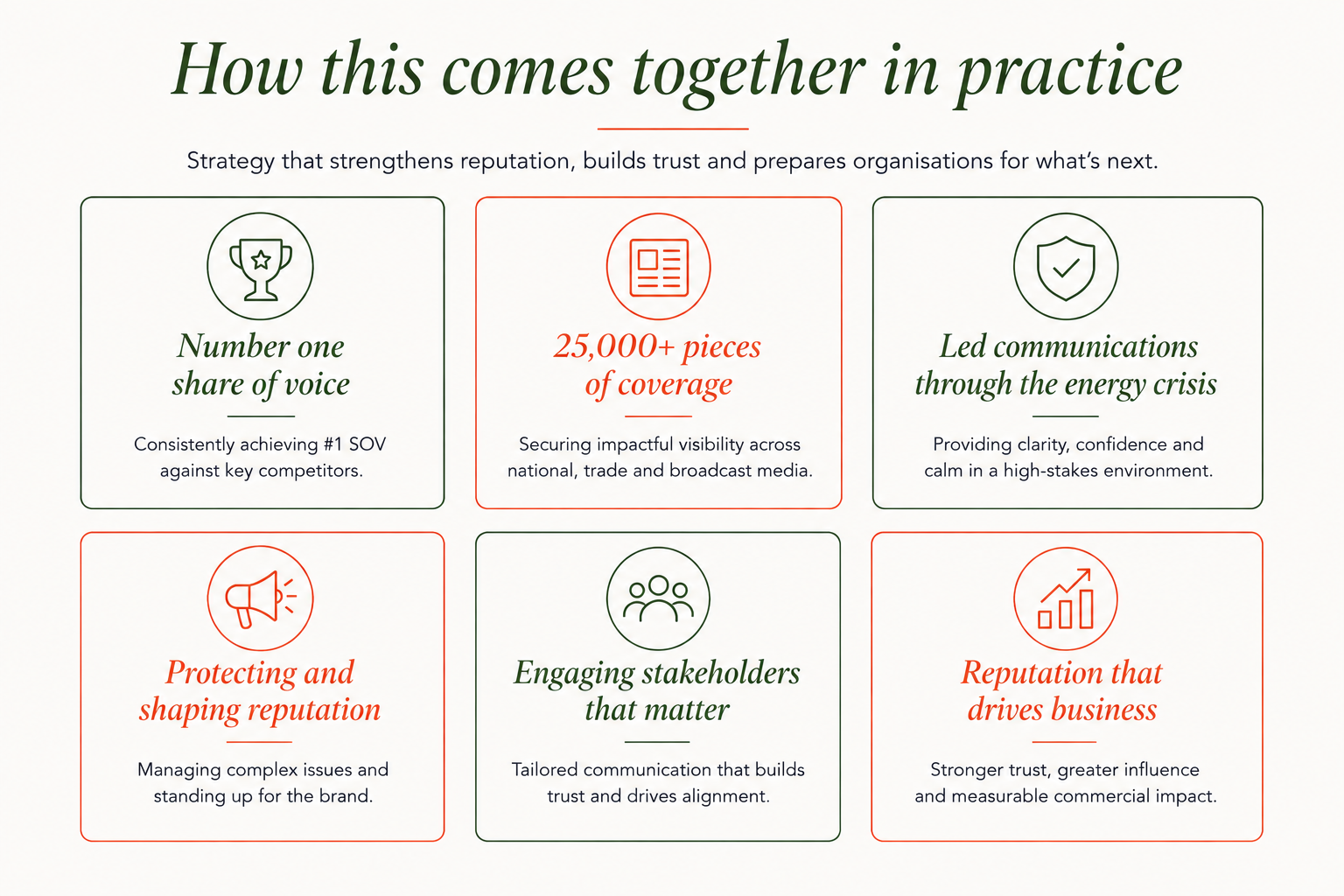
Across roles including Head of PR and Content at Chemist4U and myBMI, and Head of Content Marketing at RVU across Uswitch, Confused.com and money.co.uk, I have built and led corporate communications functions that needed to prove their value directly against commercial and reputational outcomes, not simply activity metrics. That has meant building message architecture from scratch for organisations moving from relative obscurity to category leadership, preparing spokespeople for high visibility moments including the energy crisis coverage I led across regulatory, media and consumer audiences at Uswitch, and building the kind of consistent, proactive narrative that earns genuine trust over time rather than manufacturing it in a moment of need.
That experience spans agency leadership at M&C Saatchi PR and Launch PR, alongside in-house roles where corporate communications has needed to hold its own against hard commercial targets. The discipline has evolved considerably over two decades, and the emergence of AI search is simply its latest evolution, one more reason why the fundamentals of consistency, transparency and proactive narrative building matter more, not less.
Great work starts with a spark. Discover the Spark at www.robbiecentellas.com.

About the author
Robbie Centellas is a senior marketing and communications consultant with almost two decades of experience across PR, digital PR, content, corporate communications and crisis communications. His work includes leading a digital PR programme at RVU delivering 25,000+ pieces of coverage and 16,000+ high-authority backlinks, and developing the Eat Less Move More campaign with Amy Tapper and Fat Tony. Read more about Robbie.
Corporate Communications Strategy FAQs
-
Corporate communications protects and builds the reputation of the organisation itself across every stakeholder group, including investors, employees, regulators and the media. Marketing communications is focused on driving demand for specific products or services. The two disciplines work closely together but answer to different objectives.
-
Without a clear, shared set of core narratives, different spokespeople, regions and business units end up describing the same organisation in inconsistent ways. That inconsistency is one of the fastest ways to erode stakeholder trust, since every audience, from investors to AI systems summarising your coverage, is looking for alignment between what you say and what you do.
-
A strong corporate communications strategy is what builds the reservoir of trust an organisation draws on during a crisis. Organisations that have been transparent and proactive over time earn the benefit of the doubt when something goes wrong, while those that have been silent or inconsistent do not. Crisis communications is a distinct discipline in its own right, built on process and governance, but it performs far better when it sits on top of strong ongoing corporate communications.
-
When investors, journalists, potential employees or partners search for information about an organisation, there is now a meaningful chance they receive an AI generated summary rather than a list of links. Those summaries draw on whatever content is most consistent, current and authoritative, so organisations that have been proactive and accurate in their public communications tend to be represented favourably, while gaps or inconsistencies get surfaced and repeated.
-
Executive positioning should always be grounded in genuine expertise and a real point of view, not simply visibility for its own sake. The most credible spokespeople are prepared through proper media training and message discipline, then given platforms, whether interviews, bylines or speaking opportunities, where their expertise is actually relevant to the audience.
-
I treat it as a living function rather than a document written once and filed away. Sentiment, share of voice, message consistency and AI search representation should be tracked continuously, with a fuller strategic review at least annually or whenever there is significant organisational change such as a leadership transition or restructuring.