
AI in content: what I actually built and what I learned
Everyone has an opinion about AI in content marketing. Most of those opinions are either uncritically enthusiastic or reflexively sceptical and very few of them are based on actually building and running an AI-assisted content operation in a regulated environment.
I did that. Here is what I learned.
At Chemist4U, I led content marketing strategy across three healthcare websites, a team of six in-house writers and editors plus ten regular freelancers, producing everything from clinical guides to campaign content to SEO-optimised health articles. The volume was significant and the quality bar was non-negotiable because we were a pharmacy operating in a clinically regulated environment where inaccurate health information had real consequences.
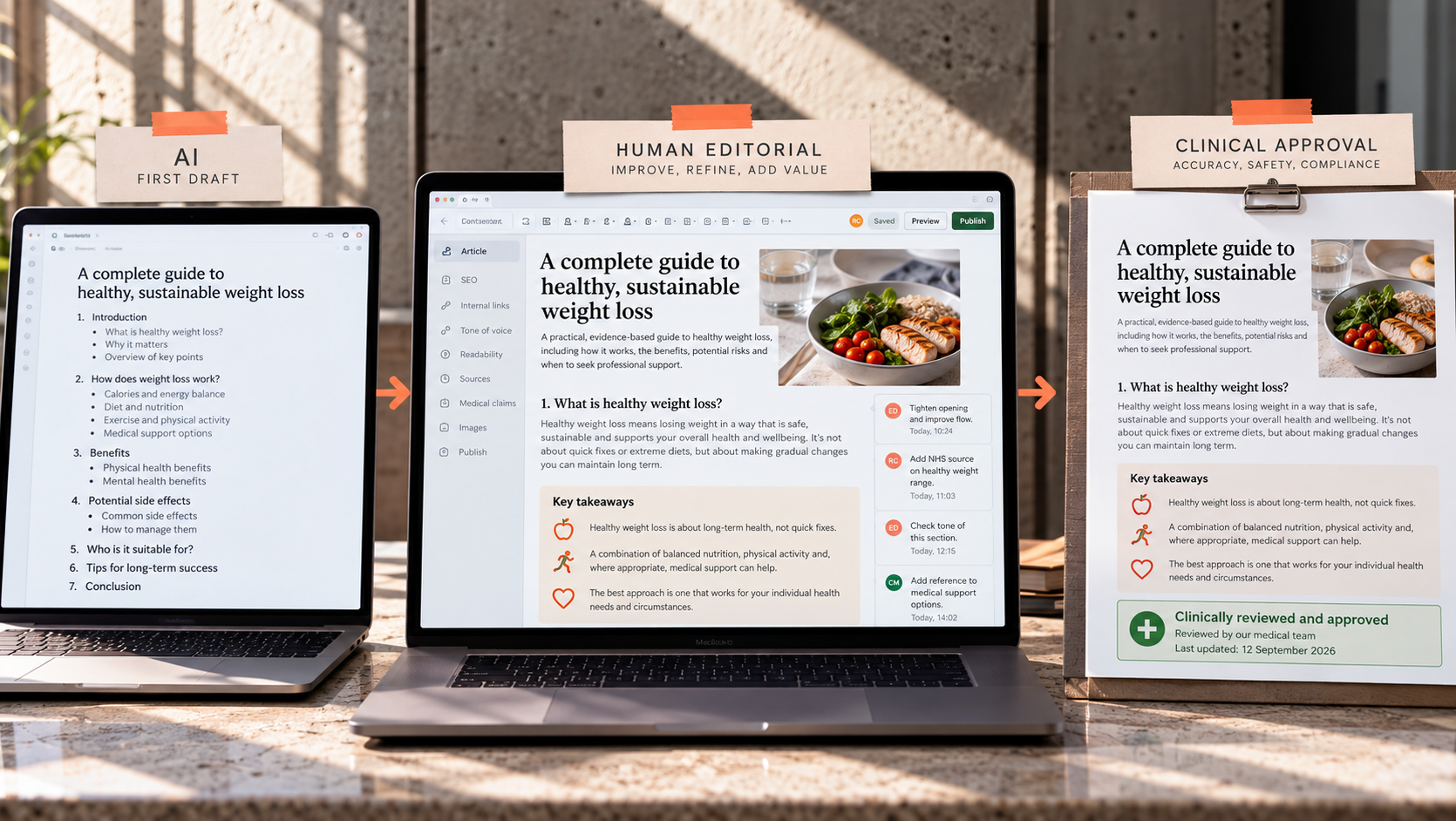
The model we developed had three layers.
The first layer was AI tools. We used it to generate first drafts at scale, giving writers a structured starting point rather than a blank page. This sounds simple but the productivity gain was significant. The time writers spent staring at a cursor dropped dramatically. The time they spent editing, improving and genuinely thinking about the content went up.
The second layer was human editorial judgment. Every piece of AI-generated content went through a human editor before it went anywhere near publication. The editor's job was to bring tone of voice, accuracy, personality and the kind of nuanced clinical understanding that AI cannot replicate. This layer was not optional and it was not a light touch. It was where the real content work happened.
The third layer was clinical approval. Every piece of health content was reviewed and approved by a medical professional before publication. This was the non-negotiable gate that protected our readers, our regulatory standing and our reputation.
What I learned from running this model for almost a year is that AI is genuinely useful as a production tool and genuinely limited as a thinking tool. It is excellent at generating structure, drafting at pace and maintaining consistency across high volumes of content. It is poor at genuine insight, editorial judgment, tone of voice and understanding the human context that makes health content actually useful to the people reading it.
The brands that will use AI well in content are the ones that treat it as a starting point rather than a finished product. The ones that invest in the human editorial layer rather than cutting it in the name of efficiency. And the ones that build the governance processes that ensure AI-generated content is accurate, responsible and properly reviewed before it reaches the people it is supposed to help.
AI did not replace my writers. It made them faster. The judgment, the instinct, the craft, that remained entirely human. And in a regulated environment, that is exactly as it should be.
Read more about the services I offer, including AI and GEO strategy, content marketing strategy and Digital PR strategy.
If you are looking for senior communications expertise that combines strategic instinct with smart use of AI, get in touch to discuss how I work.
About the author
Robbie Centellas is a senior marketing and communications consultant with almost two decades of experience across PR, digital PR, content, corporate communications and crisis communications. His work includes leading a digital PR programme at RVU delivering 25,000+ pieces of coverage and 16,000+ high-authority backlinks, and developing the Eat Less Move More campaign with Amy Tapper and Fat Tony. Read more about Robbie.
