
How to measure Digital PR: the metrics that actually matter

Coverage volume is the easiest thing in PR to measure, and the least useful thing to obsess over. I learned this properly at Chemist4U, where we were regularly landing 300 or more pieces of coverage a month. On paper, that number looked brilliant in every report. In practice, it told me almost nothing about whether the work was actually building the brand, moving rankings, or driving revenue. Some months the coverage volume barely changed and the commercial impact was enormous. Other months it spiked and did almost nothing.
If you're still measuring your digital PR strategy primarily by counting clippings, you're measuring the easiest thing to count, not the thing that actually matters. Here's how I think about it instead, built from watching this discipline's measurement genuinely evolve over close to two decades.
The evolution I've lived through
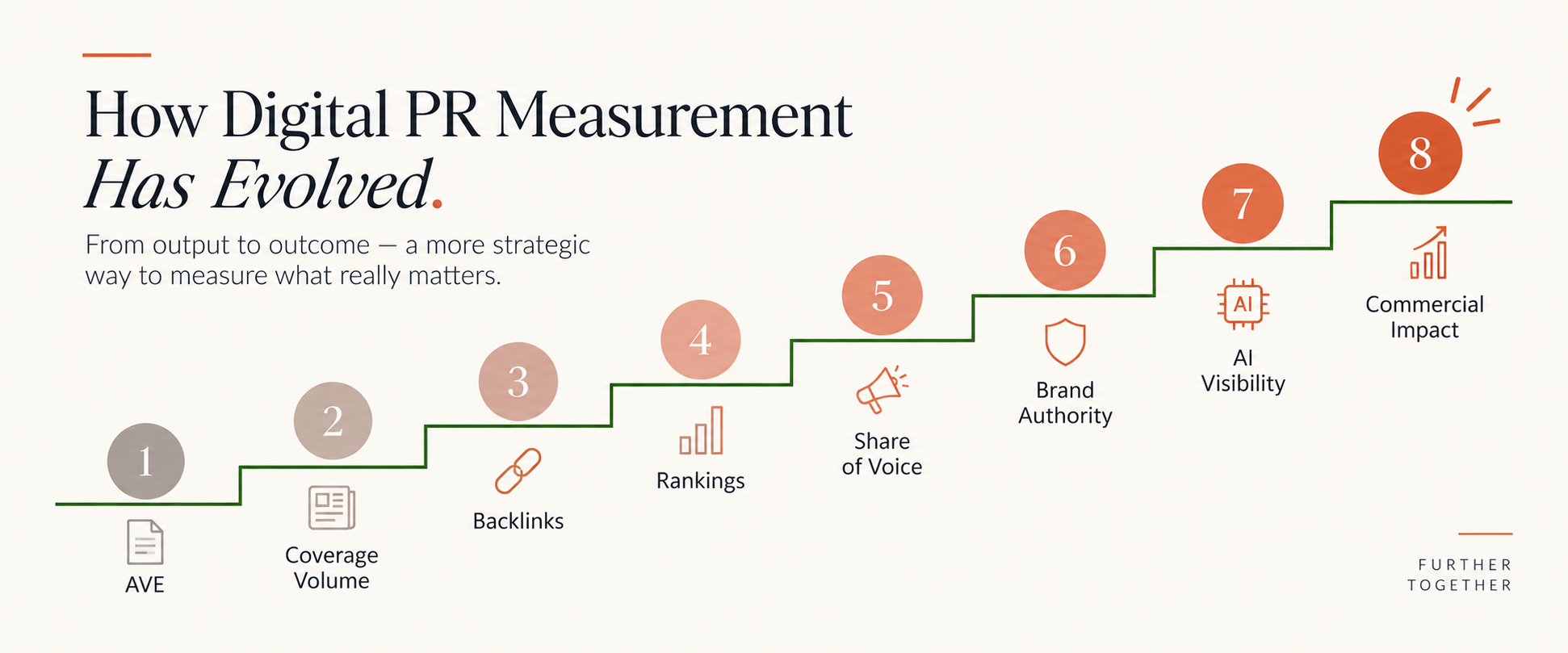
When I started in PR, success was measured in Advertising Value Equivalent, a number that tried to put a price tag on coverage by comparing it to what the same space would have cost as an advert. It was always a fiction, a way of making PR legible to people who only trusted numbers that looked like media spend. Over the years, the industry moved past AVE toward raw coverage volume instead, which felt more honest, at least it was counting something real, but it still answered the wrong question. Volume tells you activity happened. It doesn't tell you whether that activity built anything.
Then came backlinks and rankings, which genuinely changed what good PR needed to look like, since a link from a credible source started doing measurable work for organic search performance, not just brand awareness. That shifted into share of voice, understanding your coverage relative to named competitors rather than in isolation. And now, we're in the middle of another shift entirely, toward brand authority signals that feed AI generated search results, and ultimately, back to where this always should have been anchored, commercial impact.
That's the real arc: AVE, to coverage volume, to backlinks, to rankings, to share of voice, to brand authority, to AI visibility, to commercial impact. Most PR measurement conversations still get stuck somewhere in the middle of that list. The metrics that actually matter sit at both ends, the authority signals in the middle, and the commercial outcome they're supposed to produce.
Why coverage volume alone misleads you
At Chemist4U, hitting 300+ pieces of coverage in a month felt like the headline stat every reporting cycle. But when I actually pulled apart what was working, the picture was far more specific than "more coverage is better." A handful of pieces on genuinely authoritative health and consumer titles moved the needle on rankings and organic visibility far more than fifty pieces on smaller, less relevant sites ever did. Across the full programme, we built over 30,000 pieces of coverage and more than 16,000 high authority backlinks, and the lesson those numbers actually taught me wasn't "do more." It was that a relatively small proportion of that coverage was doing almost all of the real work.
If you're reporting coverage volume as your headline metric without segmenting for source authority and relevance, you're very possibly celebrating the wrong thing.
What backlinks and rankings actually tell you, if you look properly
A backlink is not a trophy. It's a signal, and the strength of that signal depends entirely on where it comes from. This is where I think a lot of PR measurement still gets lazy, treating all links as roughly equivalent because they're easier to count that way. In reality, a single link from a nationally recognised, topically relevant publication does more for both traditional rankings and, increasingly, AI search authority than dozens of low relevance placements combined.
The practical test I use with clients: for every reported backlink, ask whether it came from a source that would make a well informed reader in your category actually trust the brand more. If the honest answer is no, that backlink is a vanity number wearing an SEO metric's clothing.
Share of voice is where PR starts proving its strategic worth
Taking Chemist4U to the number one share of voice position in UK health media wasn't a coverage volume story, it was a relative one. Share of voice forces you to measure PR against the market you're actually competing in, not against your own activity in isolation. It's a genuinely more honest metric than raw output, because it answers the question that actually matters to a business: are we winning the conversation, or just making noise inside it.
Brand authority and AI visibility are the newest, and most revealing, layer
This is where digital PR measurement is heading right now, and where I think most organisations are still under prepared. The consistency and authority signals that PR has always tried to build, credible third party validation, a coherent narrative repeated across trusted sources, are now directly feeding how AI systems represent a brand when someone asks about it. I've written in more depth about exactly how that mechanism works, and what it means practically for a digital PR strategy, on my Digital PR Strategy page, worth a read if this is new territory for you.
And at the end of all of it, commercial impact
Every layer above exists to serve this one. Coverage, links, rankings, share of voice, AI visibility, none of it means anything if it doesn't eventually show up in the business outcomes that actually matter, whether that's organic traffic, conversion, revenue, or category leadership that translates into commercial advantage. The reporting I build for clients always closes the loop back here, because a PR programme that can't eventually connect its activity to a commercial outcome is a PR programme that will eventually lose its budget, and honestly, probably should.
The uncomfortable truth about most PR reporting
Most PR measurement is still built to make the PR function look busy, not to make it accountable. Coverage volume is the easiest number to report and the least likely to get genuinely interrogated in a board meeting. The metrics that actually matter, source authority, share of voice against named competitors, downstream ranking and revenue impact, take more work to track and more honesty to report against, especially in months when the story isn't as flattering. That's exactly why they're the ones worth building your measurement framework around.
If you are looking for senior communications expertise that combines strategic instinct with smart use of AI, get in touch to discuss how I work.
About the author
Robbie Centellas is a freelance PR and communications consultant based in London, with almost two decades of experience across PR, content, social and brand communications. He led a digital PR programme at RVU, delivering 25,000+ pieces of coverage and 16,000+ high-authority backlinks across Uswitch.com, Confused.com and money.co.uk, and has worked with organisations including Chemist4U, myBMI.ie and Novo Nordisk's clinical team. Read more about Robbie.
