
PR statistics 2026: the PR statistics you need to know

PR in 2026 isn't just about getting coverage. The coverage you earn now shows up in search results, in AI answers and in the sources people trust when they're deciding who to buy from.
I've pulled together the latest PR statistics from 20 organisations, from the ONS and Ofcom to Oxford's Reuters Institute, YouGov, Ipsos and the big PR industry surveys. They cover how journalists work, how people find news and brands, what's happening in the UK PR industry and how much AI relies on earned media.
Every stat is sourced and dated, and I've gone back to the original research wherever I could. After each section, I've added my take on what it actually means for comms teams. It's the same evidence that shapes how I approach Digital PR and brand building for clients.
PR statistics 2026: at a glance
84% of the links cited by ChatGPT, Claude and Gemini come from earned media, according to an analysis of more than 25 million links across 17 industries (Muck Rack, 2026)
69,470 people work as PR practitioners in the UK, up 53% from 45,359 in 2011 (CIPR analysis of census data, 2025)
35% of UK businesses with 10 or more employees now use at least one AI technology, up from around 12% in late 2023 (ONS, 2026)
21% of UK adults now use AI to access news content (Ofcom, 2026)
66% of journalists rely on content from PR teams, such as press releases, pitches and media kits, for story ideas (Cision, 2026)
3x: branded web mentions correlated with AI Overview visibility at 0.664 across 75,000 brands, compared with 0.218 for backlinks (Ahrefs, 2025)
8% of US Google visits with an AI summary led to a click on a traditional search result, compared with 15% of visits without one (Pew Research Center, 2025)
6% of Britons trust social media influencers to tell the truth, the lowest score for any profession since the index began in 1983 (Ipsos Veracity Index, 2025)
54% of people now use social media and video networks for online news, ahead of news brands' own websites and apps at 51% (Reuters Institute, 2026)
35% of communications professionals say linking PR metrics to business KPIs is the biggest barrier to measuring properly (Meltwater via AMEC, 2026)
1. PR and earned media statistics
How much influence does earned media have in 2026?
Short answer: a lot. Earned media is now one of the main things AI tools draw on when they describe a brand. It's still where journalists get most of their story ideas. And people now rate trust as highly as price and quality when they buy.
Source: Muck Rack, 2026
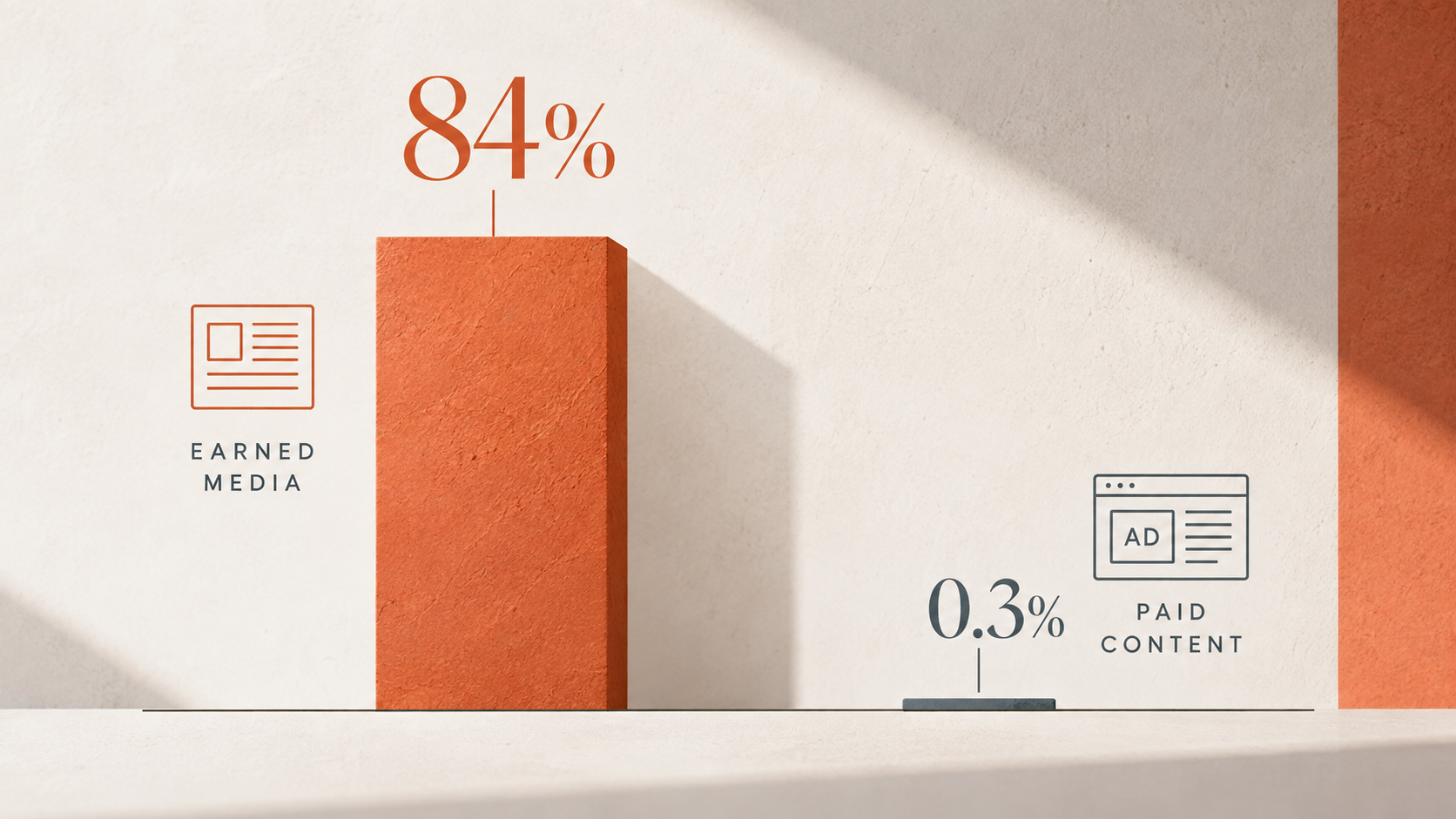
Earned media accounts for 84% of all AI citations, based on more than 25 million links from ChatGPT, Claude and Gemini responses across 17 industries (Muck Rack, 2026)
Paid and advertorial content accounts for just 0.3% of AI citations (Muck Rack, 2026)
Journalism alone makes up 27% of the sources AI tools cite (Muck Rack, 2026)
Across three editions of the study since July 2025, earned media's share of AI citations has stayed between 82% and 89% (Muck Rack, 2026)
66% of journalists rely on PR-provided content for story ideas, making PR their leading source of story leads, based on a survey of nearly 2,000 journalists across 19 markets (Cision, 2026)
86% of journalists say at least some of their stories originate from PR pitches (Muck Rack, 2026)
88% of consumers say trusting a brand is an important or critical purchase criterion, on a par with quality (89%) and value (88%) (Edelman, 2026)
My thoughts:
That 84% isn't a one-off. Muck Rack has run this study three times since July 2025, and earned media has landed between 82% and 89% every time. That tells me credible coverage is simply how these tools learn about brands.
It changes what a piece of coverage is worth. We used to judge it on who read it that day. Now it keeps working for months, feeding the answers people get from Google and ChatGPT. Paid content barely shows up at all.
Edelman lands in the same place from a different angle: you can't just tell people to trust you. You have to earn it. You can't buy authority, but you can build it, and every bit of good coverage adds to the last.
2. UK PR industry statistics
How big is the UK PR industry in 2026?
The UK has around 70,000 PR people, and the profession grew by more than half in the decade to 2021. There are now more of us than there are journalists, and the work is shifting towards advice and reputation.
Between 2011 and 2021, the number of PR practitioners in the UK grew by 53%, from 45,359 to 69,470 (CIPR analysis of census data, 2025)
60% of UK PR practitioners are women, but women hold only 47% of director-level roles (CIPR analysis of census data, 2025)
44% of UK PR practitioners are aged 16 to 34 (CIPR analysis of census data, 2025)
The UK had an estimated 78,800 PR professionals and 52,400 journalists in 2025, roughly 1.5 PR people for every journalist (BuzzStream analysis of the ONS Annual Population Survey, 2026)
For the first time, UK PR practitioners named AI as the profession's biggest challenge and its biggest skills gap (CIPR, 2024)
7 in 10 UK in-house PR professionals say their organisation values PR and its strategic contribution (CIPR, 2024)
Strategic consulting is the top investment area for PR firms globally, named by 39% of respondents, and corporate reputation was the biggest growth area for consultancies over the past year (ICCO, 2026)
91% of PR professionals worldwide think AI will be the technology with the biggest impact on PR over the next five years (ICCO, 2026)
My thoughts:
That 1.5 to 1 ratio explains a lot. There are more of us pitching fewer journalists, and those journalists have less time than ever. No wonder relevance matters more than volume.
The census tells another story too. PR is a young profession, and most of us are women, but the top jobs still skew male. As PR takes on more responsibility for reputation, AI visibility and commercial results, that needs to change.
The ICCO findings show where the work is heading: advice and reputation, not just output. And the profession grew by more than half in ten years while newsrooms shrank. Organisations clearly still value what we do. The job now is proving it in the language the boardroom uses.

3. AI and PR statistics
How are PR teams using AI?
Most PR people now use AI, and that number has levelled off. Policies are finally catching up. What's missing is anyone owning AI visibility.
76% of PR professionals use generative AI, much the same as the year before (Muck Rack, 2026)
91% of PR professionals in a separate US and UK survey say they use generative AI in their work, a higher figure from a different sample and question (Cision, 2026)
51% of PR professionals now work somewhere with a formal AI policy, up from 21% in 2024 (Muck Rack, 2026)
Only 17% of UK PR practitioners use AI daily, 28% often and 28% sometimes (CIPR, 2024)
73% of PR professionals say GEO is at least somewhat important to their communications strategy (Muck Rack, 2026)
29% say no one at their organisation owns GEO, while only 24% say PR or comms owns it and 11% say marketing leadership does (Muck Rack, 2026)
How are journalists using AI?
82% of journalists use at least one AI tool, up from 77% the year before (Muck Rack, 2026)
53% of journalists don't want AI-generated pitches, mainly because of worries about accuracy and personalisation, down from 56% the year before (Cision, 2026)
How is AI changing the way people find brands?
AI is now a real way people find information, at huge scale. But people don't trust it much, especially in the UK, and plenty of us can't tell what's real anymore.
On average, there's only a 2% overlap between the journalists PR teams pitch most and the journalists AI tools cite most for a given brand (Muck Rack, 2025)
More than half of the journalism cited by AI was published in the previous 12 months (Muck Rack, 2026)
Google's AI Mode has passed 1 billion monthly active users since expanding globally, and the Gemini app now has 950 million (Google, 2026)
Gartner predicted that traditional search engine volume would fall 25% by 2026 as people switch to AI chatbots and virtual agents (Gartner, 2024)
10% of people globally use AI chatbots for news each week, up from 7%, but the UK has the lowest usage of any market surveyed at 4% (Reuters Institute, 2026)
21% of UK adults used AI to access news in the past month, rising to 37% of 25 to 34-year-olds, with ChatGPT the most popular app at 13% (Ofcom, 2026)
Trust in AI chatbot answers is 20% globally, against 37% for news overall, and just 6% in the UK, the lowest of any market (Reuters Institute, 2026)
Only 18% of UK adults trust AI to make decisions or take actions, even though 34% use it frequently (YouGov, 2025)
92% of UK consumers say AI-generated content makes it harder to trust what they see online, but only 41% feel confident they can spot it (YouGov for DoubleVerify, 2026)
The Reuters and Ofcom numbers look different because they measure different things. Reuters asked about weekly chatbot use for news. Ofcom asked about any AI use for news in the past month, including AI in search.
How many UK businesses are using AI?
35% of UK businesses with 10 or more employees now use at least one AI technology, up from around 12% in late 2023 (ONS, 2026)
Only 10% of UK businesses using AI say they use it extensively (ONS, 2026)
58% of UK businesses in the information and communication industry use AI, the highest of any sector (ONS, 2026)
55% of employees say they use AI for work or education, compared with around 35% of businesses saying they use it (ONS, 2026)
Over half of businesses using AI for visual content say it's affecting creative or design roles (ONS, 2026)
My thoughts:
Two numbers jump out for me: the 2% overlap and the 29% with no GEO owner. Put them together, and you've got an industry that knows AI visibility matters but hasn't changed how it works.
I've set out how that fits into a wider brand strategy on my AI search and GEO strategy page.
Most media lists were built around reach and relationships, not around the outlets AI actually cites. I'm not saying drop your top-tier targets. I'm saying find out which sources shape the answers people get about your category, and make sure you're in them.
The ONS data is interesting too. More employees use AI than businesses say they do, so a lot of it is happening under the radar, ahead of any policy. And with UK trust in AI answers this low, the credible sources behind those answers matter even more. I've written more about how earned media influences AI visibility and why PR is the new SEO.

4. Journalist and media relations statistics
What do journalists want from PR teams in 2026?
Relevance, above everything. Journalists are swamped, short on resources and quick to delete anything that isn't for them. But they still value PR people who bring data, experts and a clear angle for their audience.
Source: Cision, 2026
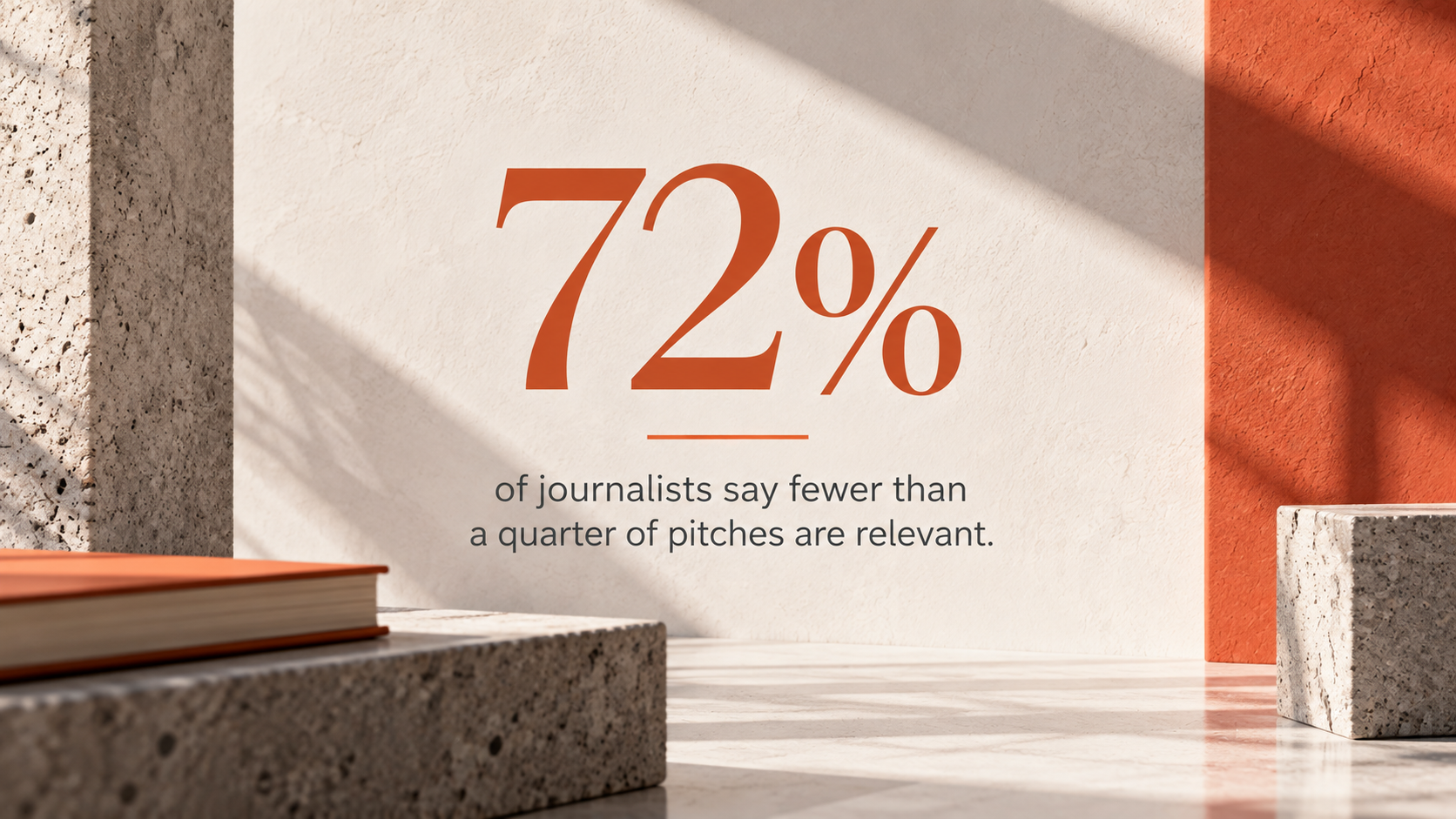
Most journalists get 50 or more pitches a week, but 72% say fewer than a quarter are relevant to their work (Cision, 2026)
88% of journalists immediately ignore pitches that miss their beat (Muck Rack, 2026)
Only 3% of journalists say the pitches they get are always relevant, while 43% say relevant pitches are rare (Muck Rack, 2026)
50% of journalists say they seldom or never respond to pitches (Muck Rack, 2026)
78% say a pitch feels relevant when it directly affects the community their audience belongs to (Muck Rack, 2026)
50% of journalists say accuracy, fact-checking and fighting misinformation is their biggest challenge (Cision, 2026)
49% say lack of resources is their top challenge, up from 29% the year before (Cision, 2026)
71% of PR professionals say response rates from journalists are low (Muck Rack, 2026)
62% of journalists use LinkedIn for work, and 33% say it's the single most valuable platform for them (Cision, 2026)
Ask journalists what makes a pitch worth reading and they say the same things: it fits their beat, it gives them access to good sources, it has original research or data, and it comes with decent images. Cision's research adds expert access and embargoed information to the list.
My thoughts:
Put both sides of this data together and you can see the problem. Journalists are drowning in pitches that aren't for them. PR teams are getting fewer replies, so they pitch more people. Nobody wins.
The fix is fewer, better pitches, built around something a journalist can't easily get elsewhere. That might be your own data, a credible expert or a real reason their audience should care.
The misinformation point matters too. Newsrooms have less time to check things, so the PR teams that get picked up are the ones whose material is accurate, sourced and easy to verify. It's also why your spokespeople need to be ready when the call comes, which is where proper media training earns its keep.
5. Digital PR and SEO statistics
How does digital PR affect search and AI visibility?
Being talked about now seems to matter more for AI visibility than links do. And AI summaries are cutting clicks from search, so being named in the answer matters more than ranking underneath it.
Across 75,000 brands, branded web mentions correlated with Google AI Overview visibility at 0.664, compared with 0.218 for backlinks, a gap of roughly three to one (Ahrefs, 2025)
A follow-up study found YouTube mentions were the strongest signal across ChatGPT, Google AI Mode and AI Overviews, with branded web mentions still correlating at between 0.66 and 0.71 (Ahrefs, 2025)
US Google users who saw an AI summary clicked a traditional search result in 8% of visits, compared with 15% for those who didn't (Pew Research Center, 2025)
Users clicked a link inside the AI summary itself in just 1% of visits (Pew Research Center, 2025)
People ended their browsing session on 26% of pages with an AI summary, compared with 16% of pages without one (Pew Research Center, 2025)
Since AI Overviews launched, the share of news searches that end without a click has risen from 56% to 69% (Similarweb, 2025)
Organic search visits to news sites fell from more than 2.3 billion at their mid-2024 peak to under 1.7 billion (Similarweb, 2025)
Google organic search traffic to more than 2,500 news sites fell by a third globally between November 2024 and November 2025, and by 38% in the US (Chartbeat data via Reuters Institute, 2026)
Publishers expect traffic from search engines to fall by 43% over the next three years (Reuters Institute, 2026)
55% of PR professionals say getting coverage in high-authority publications is their main tactic for AI visibility, while half are creating more data-led content and optimising it for search (Muck Rack, 2026)
My thoughts:
This is why I push back whenever digital PR gets reduced to link building.
The digital PR programme I led at RVU delivered more than 25,000 pieces of coverage and over 16,000 high-authority backlinks across Uswitch.com, Confused.com and money.co.uk. The links mattered. But this data suggests the bigger signal for AI is how widely and credibly a brand gets talked about. That's correlation, not proof, and it's worth being honest about that. But it points the same way as everything else in this piece.
A campaign that earns a few links but no real conversation is leaving value on the table. One that gets a brand discussed in the right places, link or no link, is building exactly what search engines and AI look for. That's how I approach digital PR strategy.
6. Trust and reputation statistics
How much do people trust business, media and news in 2026?
Trust in news is at a record low, and people are retreating into smaller circles they trust. Business is still the most trusted institution, and traditional media and experts are trusted far more than social media, influencers or AI.
Source: Ofcom, 2026
Trust in news overall has fallen to 37%, the lowest since the Reuters Institute started measuring in 2015 (Reuters Institute, 2026)
Trust in news fell in 29 of the 48 markets surveyed, and by five points or more in 19 of them (Reuters Institute, 2026)
Concern about fake news has risen by four points to 62% on average (Reuters Institute, 2026)
Only 28% of Americans trust the mass media to report the news fully, accurately and fairly, a record low and down from 68% in 1972 (Gallup, 2025)
Only 26% of Britons trust journalists to tell the truth, and 16% trust advertising executives (Ipsos Veracity Index, 2025)
Just 6% of Britons trust social media influencers to tell the truth, the lowest score for any profession since the index began in 1983 (Ipsos Veracity Index, 2025)
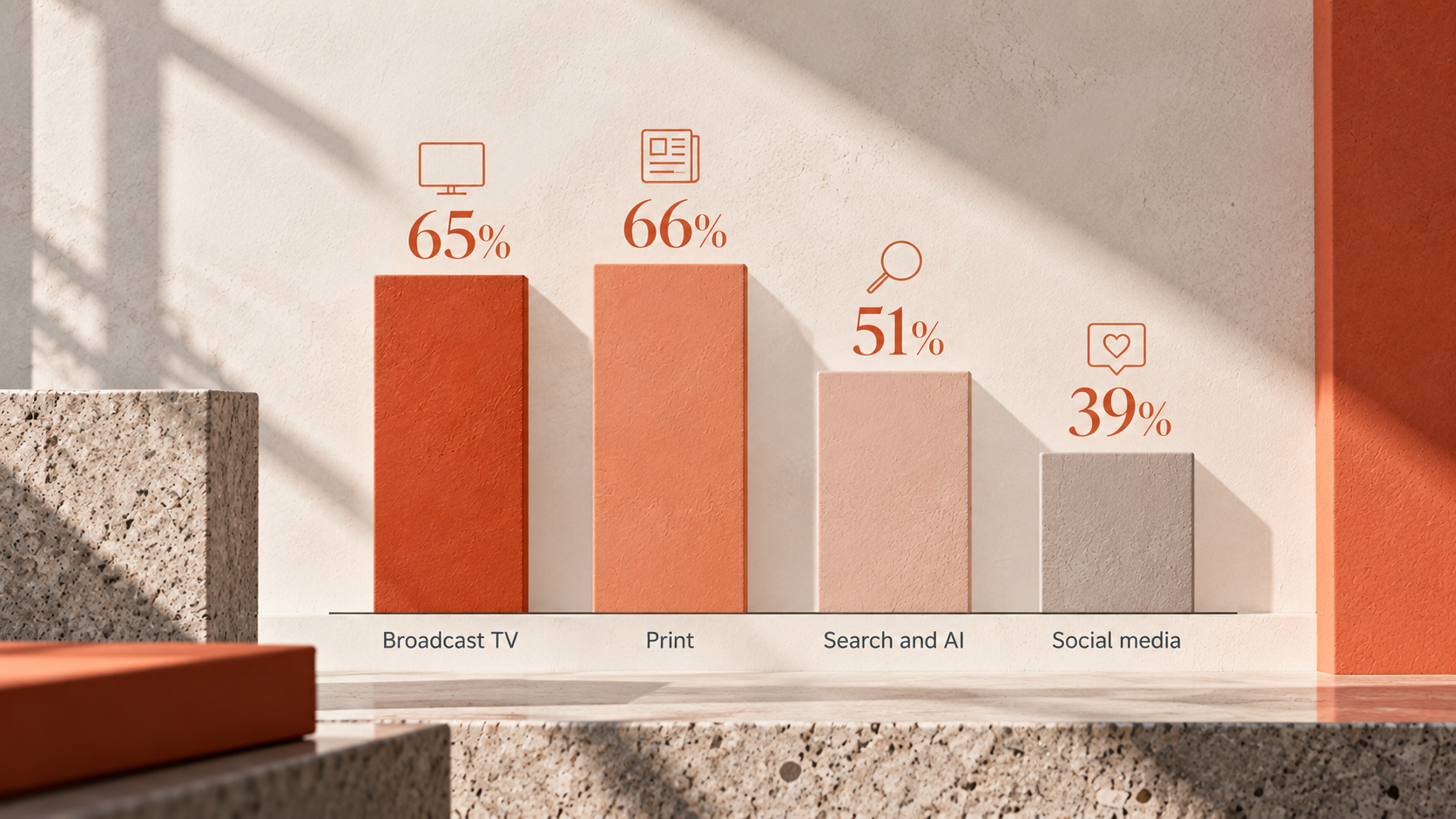
Around two-thirds of UK adults who get news from broadcast TV (65%) and printed newspapers (66%) rate them highly for trust, compared with 39% of those using social media or video platforms and 51% of those using search engines or AI (Ofcom, 2026)
Seven in ten people are unwilling or hesitant to trust someone with different values, backgrounds or information sources (Edelman, 2026)
In the UK, that figure is higher than the global average, at 76% (Edelman, 2026)
Business is still the only institution seen as both ethical and competent, and for the first time it's seen as more ethical than NGOs (Edelman, 2026)
91% of PR professionals say polarisation has made PR more important within their organisations (USC Annenberg, 2026)
Only 55% of PR professionals now agree that companies have a responsibility to speak up on social issues, and support for companies speaking out on issues unrelated to their business has fallen 38% since the killing of George Floyd (USC Annenberg, 2026)
78% of Britons say they'd trust a brand less if it used AI-generated actors in its ads, and 94% say brands should disclose it (YouGov, 2026)
One thing worth knowing: the news brands people use most are holding on to trust better than news in general.
My thoughts:
The Edelman finding on insularity is the one I'd put in front of any leadership team. If people only trust those who think like them, pushing out a corporate message and hoping it lands won't work. Credibility has to come through voices people already trust: respected outlets, real experts, employees and communities.
The USC data adds something important. PR's influence is growing just as companies are saying less, so part of our job now is knowing when to stay quiet. That judgement sits at the heart of good crisis communications planning.
And the YouGov numbers are a warning. People punish brands that fake it. That makes credible third-party validation worth more, not less. It's where corporate communications strategy and brand building through earned media come together.
7. Content and social media statistics
Where do people find news and brands in 2026?
People now find news and brands through platforms, video and creators, especially younger audiences. In B2B, good insight is doing work that traditional marketing often can't.
For the first time, social media and video networks are the most popular way to get news online globally (54%), ahead of news brands' own websites and apps (51%) (Reuters Institute, 2026)
52% of 18 to 24-year-olds globally say social media, video networks and AI chatbots are their main source of news (Reuters Institute, 2026)
41% of Gen Z go to social platforms first when looking for information, ahead of search engines (32%) and AI chatbots (11%), based on a survey of social users in the US, UK and Australia (Sprout Social, 2025)
37% of consumers of all ages prefer to search social platforms first for product reviews and recommendations (Sprout Social, 2025)
76% of social media users say social content influenced a purchase in the past six months, rising to 90% of Gen Z (Sprout Social, 2025)
77% of people globally watch online news video each week (Reuters Institute, 2026)
27% of people globally get some news from news-focused creators or influencers (Reuters Institute, 2026)
46% get some news from creators of any kind, although people see creators as less trustworthy and less impartial than traditional news outlets (Reuters Institute, 2026)
Search engines, aggregators, AI, social media and video platforms account for 37% of the time UK adults spend with news, while publisher websites account for 11% (Ofcom, 2026)
Facebook is the UK's biggest social platform for news, used by 39% of adults in the past month, followed by YouTube at 33% (Ofcom, 2026)
53% of B2B decision-makers say brand recognition matters less when a company's thought leadership is strong (Edelman and LinkedIn, 2025)
95% of hidden buyers say strong thought leadership makes them more open to sales and marketing outreach (Edelman and LinkedIn, 2025)
79% of hidden buyers are more likely to champion a vendor during an RFP if that vendor consistently publishes quality thought leadership (Edelman and LinkedIn, 2025)
My thoughts:
Nobody experiences PR, content and social as separate things. People meet a brand in a news story, a creator's video, a LinkedIn post and an AI answer, often in the same week. If each one tells a different story, trust takes a hit. That's why I think PR and content marketing shouldn't work in silos.
Read the creator data alongside the Ipsos finding that just 6% of Britons trust influencers. Creators have reach. Credibility comes from elsewhere. So influencer marketing works best alongside earned coverage, not instead of it.
In B2B, a sharp point of view can beat a bigger brand name. That's where a proper content marketing strategy earns its place. The real advantage comes from making owned, earned and paid media work together. In B2B, a sharp point of view can beat a bigger brand name.

8. PR measurement statistics
How are PR teams measuring impact in 2026?
Most PR teams still report outputs like placements and reach, even though what's holding them back is linking that work to business results. And almost nobody is measuring AI visibility yet.
21% of communications professionals say measuring impact and ROI is one of their biggest challenges, and 24% point to a lack of resources, based on more than 1,100 respondents (Meltwater via AMEC, 2026)
The biggest barriers to measuring properly are linking PR metrics to business KPIs (35%), proving PR's value to leadership (28%) and relying too much on old metrics (22%) (Meltwater via AMEC, 2026)
51% of communications professionals expect budgets to stay flat in 2026, while 17% expect cuts (Meltwater via AMEC, 2026)
Around 60% say their leadership understands PR well or very well, so around 4 in 10 don't feel that way (Meltwater via AMEC, 2026)
39% of PR professionals aren't measuring GEO at all, even though 45% say media measurement is a big part of their job (Muck Rack, 2026)
Brand awareness is still PR's top priority for 36% of professionals, but executives (32%) and agencies (33%) are far more focused on revenue and ROI (Cision, 2026)
And the two most common ways of judging PR success? Still the number of placements and reach or impressions.
My thoughts
Coverage volume and impressions tell you something happened. They don't tell you whether it worked. Did the right people see the right messages? Did what they think change? Did branded search, enquiries, or share of voice move?
The Cision data shows the gap. Leaders want commercial results, and a lot of teams are still reporting awareness. The teams that close that gap protect their budgets and their seat at the table.
There's something new to add too. If earned media shapes how AI describes your organisation, then tracking where and how you show up in AI answers belongs in your measurement. Right now, most teams aren't doing it.
What do the PR statistics tell us about 2026?
Three things come through clearly in all this research.
PR is getting more measurable, and more accountable. The tools exist, and leaders now expect commercial results. Teams still reporting only outputs will find their budgets harder to defend.
Earned coverage now shapes how people find brands, well beyond traditional media. The same coverage that builds your reputation with readers is shaping what AI says about you. Paid content barely features, and people are increasingly wary of anything that looks fake or bought.
PR, content, search and social are getting harder to separate. People find brands through platforms, creators, search and AI, and every one of those rewards the same thing: consistent, credible signals.
So the opportunity isn't just more coverage. It's building credible third-party authority, useful owned content and a consistent story that backs up what you want to stand for, wherever people, search engines or AI come across you.
If you are looking for senior communications expertise that combines strategic instinct with smart use of AI, get in touch to discuss how I can help.
Sources
Official statistics and regulators
Office for National Statistics, Artificial intelligence in UK businesses: 2023 to 2026 (Business Insights and Conditions Survey, Wave 159, July 2026)
Ofcom, News Report 2026 (5,397 UK adults, September 2026)
Academic and non-profit research
Reuters Institute for the Study of Journalism, Digital News Report 2026 (48 markets), including Chartbeat publisher traffic data
Pew Research Center, Google users are less likely to click on links when an AI summary appears (900 US adults, 2025)
USC Annenberg Center for Public Relations, 2026 Global Communication Report
Professional bodies
CIPR, PR Population Report, UK-wide edition (December 2025, analysis of census data from ONS, National Records of Scotland and NISRA)
CIPR, State of the Profession 2024 (2,000+ respondents)
ICCO, World PR Report 2025/26 (powered by Opinium)
Polling and trust research
Edelman, 2026 Edelman Trust Barometer (33,938 respondents, 28 countries)
Edelman, 2026 Special Report: Brand Growth in an Insular World (17,688 respondents, 15 countries)
Edelman and LinkedIn, 2025 B2B Thought Leadership Impact Report (nearly 2,000 management-level professionals)
Ipsos, Veracity Index 2025
YouGov, Trust in AI (December 2025) and AI-generated actors in advertising (July 2026, 2,012 UK adults)
DoubleVerify and YouGov, AI-generated content and trust (July 2026, 2,000 UK consumers)
Gallup, Trust in Media (September 2025, 1,000 US adults, via Axios)
PR industry research
Muck Rack, What Is AI Reading? May 2026 (25 million+ links) and December 2025 editions
Muck Rack, State of Journalism 2026 (primarily US, with UK, Canada and India representation)
Muck Rack, State of AI in PR 2026 (500+ PR professionals)
Muck Rack, State of PR 2026 (971 usable responses from 1,115 surveyed, 91% US-based)
Cision, 2026 State of the Media Report (1,899 journalists across 19 markets)
Cision, Inside PR 2026 (US and UK PR professionals)
Meltwater, 2026 State of PR Report (1,100+ communications professionals, via AMEC)
Platform, search and analyst data
Google, Q2 2026 earnings remarks (July 2026)
Ahrefs, AI Overview Brand Visibility Factors (75,000 brands, 2025) and December 2025 follow-up
Similarweb, AI news referral data (2025, via Search Engine Roundtable)
Sprout Social, Q2 2025 Pulse Survey (2,200+ social users in the US, UK and Australia)
Gartner, Search engine volume prediction (February 2024)
BuzzStream, How Many Journalists Are There in the UK? (2026, analysis of the ONS Annual Population Survey)
About the author
Robbie Centellas is a senior marketing and communications consultant with almost two decades of experience across PR, digital PR, content, corporate communications and crisis communications. His work includes leading a digital PR programme at RVU delivering 25,000+ pieces of coverage and 16,000+ high-authority backlinks, and developing the Eat Less Move More campaign with Amy Tapper and Fat Tony. Read more about Robbie.
