
How to get your brand mentioned by ChatGPT: the PR strategy behind AI search visibility

Getting mentioned by AI isn't simply an SEO problem. It's an authority problem, and that's what makes PR increasingly important to search visibility.
The brands showing up in ChatGPT answers aren't the ones with the cleverest prompts or the most technically optimised website. They're the ones with credible, consistent, corroborated information sitting across the wider web, built up over time by people other than the brand itself.
That distinction matters, so it's worth being precise about it from the outset. This isn't an argument that PR magically makes ChatGPT recommend you. It's that brands need to become understandable, trustworthy entities in AI-mediated discovery, and PR has always been the discipline built around exactly that job.
Why does ChatGPT mention some brands and not others?
There isn't a single "ChatGPT ranking algorithm" that brands can optimise for in the way marketers once thought about Google rankings. ChatGPT and other AI systems draw on a combination of learned knowledge from training data, retrieved and indexed web information, live search results and other sources, depending on the product, the query and which mode is being used.
That means a business cannot simply optimise its own website and expect to control what the answer says. A well built site helps, but it's one input among several, and often not the most influential one.
Research bears this out directly. An Ahrefs study of 75,000 brands found that unlinked brand mentions across the web correlate with AI Overview visibility at 0.664, compared with just 0.218 for backlinks, a gap of roughly three to one.
Separate analysis by Muck Rack of over a million AI-cited links found that 82 to 95 percent of AI citations trace back to earned media coverage rather than a brand's own website. If the goal is to influence what ChatGPT says about a business, the evidence points away from the website alone and towards the wider information environment the brand sits inside.
Can you optimise your brand for ChatGPT?
Yes, but not by optimising ChatGPT itself. What can be optimised is the information ecosystem surrounding the brand: the things journalists, publishers, forums, review sites and other independent sources say, and how consistently they say it.
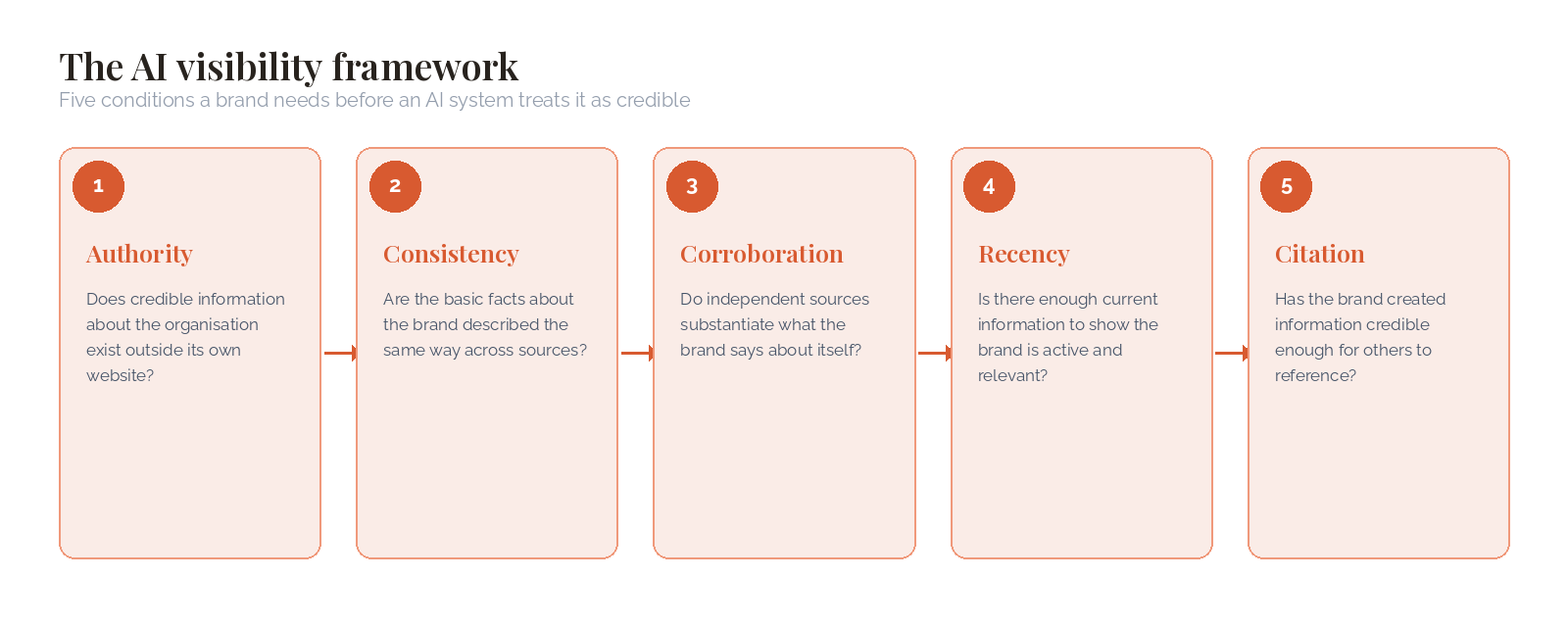
I think about this as five conditions a brand needs to meet before an AI system has any reason to treat it as a credible answer.
Authority. Does credible information about the organisation exist outside its own website, in places an AI system already trusts?
Consistency. Are the basic facts, such as what the company does, who leads it and what it's known for, described the same way across the sources that mention it?
Corroboration. Do independent sources substantiate what the organisation says about itself, rather than simply repeating its own marketing language?
Recency. Is there enough current information in circulation to show the brand is active, relevant and still operating in the way it claims to?
Citation. Has the organisation created information that's useful and credible enough for journalists, publishers, search engines and AI systems to reference and attribute?
Quick honesty check: authority, corroboration and citation are backed directly by the research above. Consistency and recency aren't. No study isolates them the way it isolates brand mentions or backlinks. They're standards good PR has always worked to, and I think the logic holds, but I won't pretend they carry the same weight of proof as the other three.
Authority, consistency, corroboration, recency and citation. None of these are new PR objectives dressed up in AI language. They're the same standards good communications practice has always aimed for. What's changed is the audience reading the results.
Why PR matters to AI search visibility
Traditional SEO thinking is often reduced to a fairly simple relationship: website, then Google. Optimise the site, build some links, rank for the query.
AI discovery widens that picture considerably. The path now runs from the brand itself, through its website, media coverage, expert commentary, industry sources, original research and third-party references, into the AI or search system, and only then to the audience.
Every one of those intermediate points is a place PR has always operated, and most of them sit entirely outside a brand's own domain, which is exactly why a website-only optimisation strategy runs out of road.
This is also why digital PR and AI visibility are converging rather than sitting in separate disciplines. The activity that earns a brand credible third-party coverage is largely the same activity that builds the wider information environment an AI system draws on when deciding what to say about that brand.
I've written before about why PR is the new SEO, breaking down the earned media work that builds authority and corroboration in practice. This piece sets out the framework behind that work and the evidence for why it holds up.
Does media coverage help brands appear in ChatGPT?
The honest answer is nuanced, and it's worth resisting the temptation to overstate it. Getting coverage in a national title doesn't guarantee ChatGPT will start recommending a brand.
What authoritative earned coverage does is create independent corroboration, clear brand and entity associations, expert attribution and factual, discoverable information that sits outside a brand's owned channels, which is precisely the material research shows AI systems draw on most heavily.
The evidence for this is more concrete than it might sound. Analysis of AI citation patterns finds that a relatively small number of high authority domains account for a disproportionate share of citations.
News outlets, encyclopaedic sources and professional platforms form a consistent middle and top tier across ChatGPT, Perplexity and Google's AI features.
Sources such as Reuters, Forbes, Business Insider and PR Newswire appear repeatedly among the most cited domains, and PR Newswire in particular saw one of the largest citation gains of any single domain following a 2025 change to how ChatGPT sources answers, a shift widely read as evidence that structured, well distributed press material is increasingly extractable and machine readable.
None of that is proof that any single placement moves the needle. It's evidence that the category of activity, earned coverage in credible, independent sources, is structurally the kind of material these systems lean on.
Are backlinks still important for AI search?
Yes, but it's worth thinking beyond the link itself. Backlinks haven't stopped mattering, but their role has shifted from being the primary signal to something closer to a threshold condition.
Research from SE Ranking analysing over 200,000 pages found referring domains remain one of the stronger predictors of ChatGPT citation likelihood, with heavily linked domains cited far more often than lightly linked ones. But the Ahrefs data above tells a complementary story: once a domain clears that authority bar, it's brand mentions, not additional links, that do most of the work in deciding whether a brand actually gets cited.
That reframes what a contextual mention is worth. A piece of coverage that clearly associates a brand with a topic, a product, an expert or a category can carry value well beyond the traditional SEO authority a link passes on, because it's building exactly the kind of brand and entity association that citation studies show correlates most strongly with AI visibility.
This is consistent with what digital PR campaigns have always been built to do. At RVU, I generated over 16,000 backlinks through digital PR activity, and the campaigns that performed best for search were rarely the ones chasing raw link counts.
They were the ones that got a brand mentioned, in context, by sources an audience and a search engine already trusted. AI search hasn't changed that logic. It's made the case for it stronger.
Why original data becomes more valuable in AI search
This is one of the more concrete, evidence backed levers available to a communications team, and it's worth taking seriously rather than treating as a nice to have.
The founding academic research on generative engine optimisation, published by researchers at Princeton, Georgia Tech, the Allen Institute for AI and IIT Delhi, tested content optimisation strategies across roughly 10,000 queries and found that adding statistics, citing sources and including direct quotations were among the most effective ways to improve a piece of content's visibility in AI generated responses, in some conditions by as much as 40 percent.
That figure is a ceiling measured under test conditions rather than a guaranteed average in live use, but the underlying pattern, that AI systems favour content carrying specific, attributable facts, holds up consistently across the wider research on the topic.
Surveys, datasets, proprietary analysis and original research create exactly the kind of citation worthy material this points to.
There's a meaningful difference between publishing "five trends marketers need to know" and publishing "our analysis of 500 X found Y." The first is a summary of things other sources have probably already said.
The second makes the brand the origin of a fact rather than another site repeating one, and origin points are what get cited, quoted and referenced by other publishers, which is exactly the kind of independent, corroborating activity that feeds AI visibility.
For any brand already investing in digital PR, this is often less about starting something new and more about being deliberate that the research and data at the centre of a campaign is built to be cited, not just covered.
Five things I'd do if my brand wasn't appearing in AI search
If a brand isn't showing up in AI generated answers, here's the order I'd work through the problem in.
Audit what AI systems currently say about the brand, across ChatGPT, Perplexity and Google's AI features, not just one of them
Identify which competitors are being mentioned instead, and for which specific questions
Compare those competitors' third party authority and coverage against the brand's own
Create genuinely citation-worthy information, whether that's original research, expert commentary or clearly structured factual content
Use digital PR to distribute and validate that information across sources an AI system already treats as credible
That sequence matters. Skipping straight to step four, publishing more content, without first understanding what's already being said and who's winning the comparison, is how a lot of AI visibility efforts waste budget on the wrong problem.
What should PR teams measure?
AI visibility deserves its own measurement, but it shouldn't invent a vanity metric to sit alongside everything else unexamined. I'd track six things.
Brand inclusion, meaning whether the brand is mentioned at all for relevant queries
Category association, meaning which topics and questions trigger the brand being mentioned
Competitive share, meaning which competitors appear more often, and for what
Citation and source visibility, meaning which sources an AI system is drawing its answer from
Accuracy, meaning whether the facts an AI system states about the brand are actually correct
Sentiment and context, meaning how the brand is characterised when it does appear
AI visibility should sit alongside conventional measures, not replace them. Search visibility, earned coverage volume and quality, backlink profile, share of voice and referral traffic all still matter.
What's changed is that a communications team now has one more channel worth watching, and one that's likely to grow rather than shrink in importance over the next few years.
The future of PR is partly search
PR has always shaped what people know about organisations. What's changing is who, or what, is doing the reading.
Journalists, customers and search engines are now joined by AI systems trying to work out which organisations are credible enough to surface in an answer.
The skills that answer that question, building authority, keeping the story consistent, earning independent corroboration and creating information worth citing, are the same skills good PR has always required. The audience has simply grown to include a few more machines.
For businesses trying to work out where AI visibility fits alongside their existing Digital PR strategy or content marketing strategy, the starting point isn't a new discipline. It's making sure the fundamentals of corporate communications and earned media are doing double duty, for the humans reading them and the systems increasingly reading over their shoulder.
Want to know what AI systems are currently saying about your brand?
If you're not sure how your business currently shows up in ChatGPT or Google's AI features, or want a second opinion on where a digital PR programme should focus, I'm happy to talk it through. Talk to me about your project.
Frequently asked questions I get
Can I make ChatGPT recommend my company? Not directly. There's no paid placement or submission process that guarantees a mention. What a business can influence is the volume, consistency and credibility of independent information about it across the web, which is what AI systems draw on when deciding what to say.
How does ChatGPT choose which brands to mention? ChatGPT draws on a mix of training data, retrieved web content and, depending on the mode, live search results. Research shows brand mentions across independent, credible sources correlate far more strongly with visibility than a brand's own website or backlink count.
What is GEO? GEO stands for generative engine optimisation, a term formalised in 2023 by researchers at Princeton, Georgia Tech, the Allen Institute for AI and IIT Delhi. It describes the practice of structuring content and brand information to improve visibility in AI generated answers.
Is GEO different from SEO? They overlap but aren't identical. SEO optimises primarily for ranking a website in a list of links. GEO is concerned with whether and how a brand is mentioned inside an AI generated answer, which depends more heavily on off-site brand signals than website optimisation alone.
Does PR help with AI search? Yes, largely through the same mechanism it's always worked through: earning credible, independent coverage that corroborates what a brand says about itself. Research puts the share of AI citations traced back to earned media, rather than owned websites, at between 82 and 95 percent.
Do backlinks affect ChatGPT visibility? Partially. Backlinks still correlate with citation likelihood, particularly as a baseline authority signal, but multiple studies now show branded mentions, including unlinked ones, correlate more strongly with AI visibility than link volume alone.
How do I measure my brand's visibility in AI search? Track brand inclusion, category association, competitive share, citation sources, factual accuracy and sentiment across the AI platforms relevant to your audience, alongside existing measures like earned coverage and organic search visibility, rather than as a replacement for them.
Methodology
The sources behind this piece are linked directly rather than just named, so you or a reader can check them.
Ahrefs, An Analysis of AI Overview Brand Visibility Factors (75,000 brands, 2025, with a December 2025 follow-up across ChatGPT, Google AI Mode and AI Overviews)
Muck Rack, What Is AI Reading? (analysis of over one million AI-cited links)
Aggarwal, Murahari, Rajpurohit, Kalyan, Narasimhan and Deshpande, GEO: Generative Engine Optimization, Princeton University, Georgia Tech, the Allen Institute for AI and IIT Delhi, published at ACM SIGKDD 2024
SE Ranking, How to optimize for ChatGPT (129,000 domains and 216,524 pages)
Caveat: Two of these don't fully agree,Ahrefs found backlinks correlate weakly with AI Overview visibility (0.218), well behind brand mentions (0.664). SE Ranking, testing ChatGPT specifically, found referring domains to be the single strongest predictor of citation likelihood. The two studies tested different platforms, Ahrefs mostly measured Google's AI Overviews, SE Ranking measured ChatGPT directly, so it's possible the platforms genuinely weight backlinks differently, or that the two methodologies aren't quite measuring the same thing.
Percentages presented as a range, such as the 82% to 95% earned media figure, reflect genuine variation across independent studies and report updates rather than a single fixed number. Not every claim carries the same weight of evidence either: authority, corroboration and citation, in the five-condition framework above, are backed directly by the correlation research. Consistency and recency are reasoned extensions, consistent with how retrieval and entity resolution systems generally work, not individually isolated findings in any study cited here. This is a fast moving area of research, with new studies published most months, so the specific figures are worth revisiting within the next twelve months rather than treated as fixed.
If you are looking for senior communications expertise that combines strategic instinct with smart use of AI, get in touch to discuss how I work.
