
How much does a freelance PR consultant cost in the UK in 2026?

Freelance PR consultant costs in the UK vary according to experience, scope and how the consultant is engaged. Senior consultants may charge by the day, project or monthly retainer, with costs increasing for specialist areas such as corporate reputation, crisis communications and regulated industries.
In practice, that means a business could pay anywhere from a few hundred pounds for a single day of senior counsel to several thousand pounds a month for an ongoing programme. The rest of this guide breaks down what drives that range, and what each engagement model actually buys you.
How much does a freelance PR consultant cost in the UK?
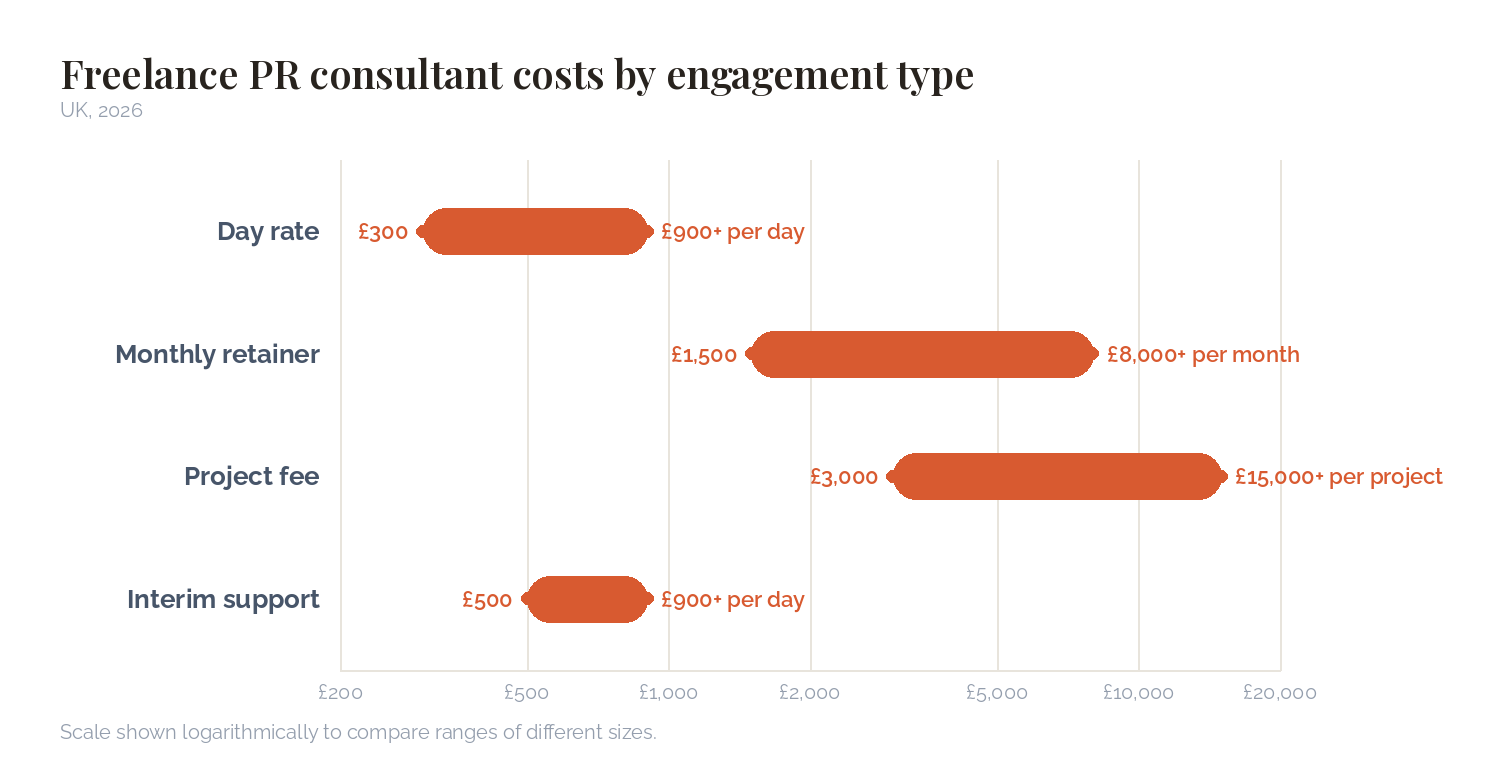
Day rates for freelance PR and communications consultants generally run from £300 to £450 a day at mid-weight level, £450 to £650 for senior consultants, and £650 to £900 for those operating at Communications Director or Head of Communications level. Specialists in crisis, ESG, policy or regulated sectors often sit above £800 a day. Monthly retainers for a solo consultant typically start around £1,500 to £3,000 for a handful of days a month, rising to £3,000 to £8,000 for more consistent, proactive activity. Project fees for a defined piece of work, a launch campaign or a strategy document commonly land between £3,000 and £15,000, depending on scope.
Price and value are not the same thing. A senior consultant charging £700 a day may cost more per day than a £350 a day mid-weight consultant, but often needs fewer days to reach the same outcome, because they can work independently, make judgement calls without escalation and operate at a strategic level from day one. The cheapest day rate on paper is rarely the cheapest way to solve the problem.
What affects the cost of a PR consultant?
A number of factors move the price up or down, often more than the headline day rate suggests.
Seniority and years of experience, particularly at Director and Head of Communications level
Whether the work is strategic (counsel, positioning, messaging) or delivery focused (writing, pitching, coordination)
The complexity of the story, sector or stakeholder landscape
How much hands-on media relations and journalist outreach is involved
Whether research, data, design or creative production is needed alongside the PR work
Crisis or reputation management, which carries a premium for availability and judgement under pressure
Regulated sectors such as finance, healthcare or public affairs, where compliance knowledge adds cost
The length of the engagement, since longer retainers are often priced more efficiently per day than one-off projects
Whether other specialists, freelancers or production costs need to be coordinated alongside the core consultant
A consultant working across several of these at once, for example a senior person handling a sensitive story in a regulated sector with active media interest, will cost considerably more than a mid-weight consultant drafting routine releases for a low risk business.
PR consultant vs PR agency: what's the difference in cost?
This isn't a case of freelancer good, agency bad. The two models suit different problems.
An agency can make more sense when a business needs a larger delivery team, several specialists working in parallel, or significant creative and content production alongside the PR itself. You're paying for breadth: account handlers, media relations executives, designers and strategists all under one roof, with the agency managing that coordination for you.
An experienced independent consultant tends to work well when the requirement is senior expertise, flexibility and direct access, without the overhead of a full agency structure. There's no account handler between you and the person doing the strategic thinking, no junior team learning on your account, and day rates that reflect one person's time rather than an agency's margin on top of several people's time. For many businesses, particularly those that need judgement and direction more than a large production team, a freelance consultant delivers the same calibre of thinking at a lower total cost.
Day rate, retainer or project fee: which should you choose?
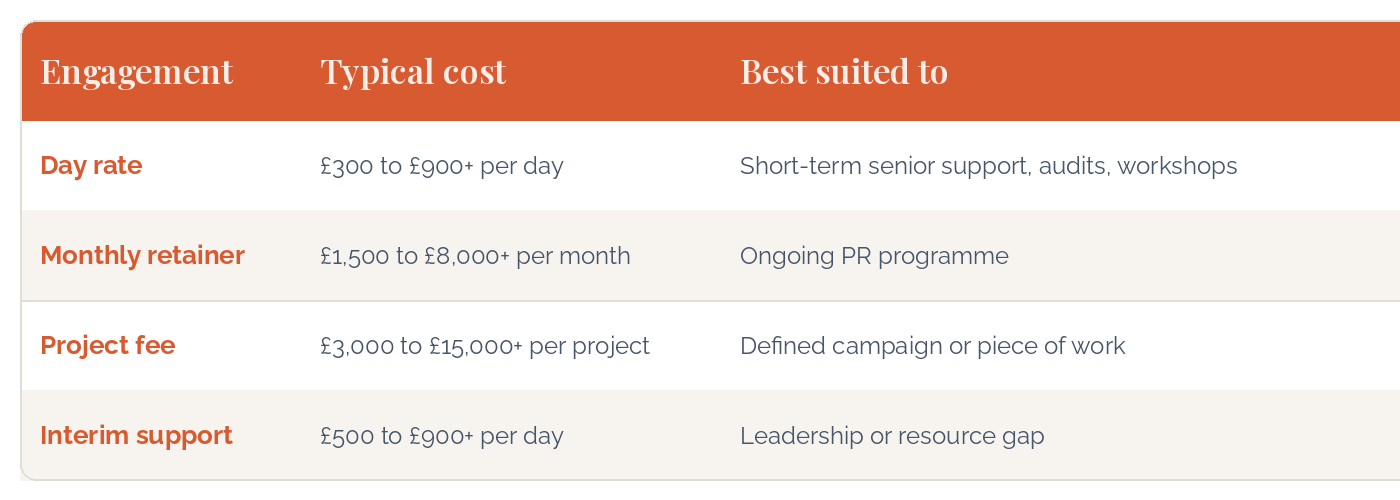
Day rate. Best for audits, workshops, short-term leadership cover and clearly defined strategic work with a fixed number of days, such as reviewing a communications strategy or leading a single stakeholder session.
Retainer. Suited to ongoing media relations, corporate communications or content and PR programmes that need consistent attention over months rather than a single burst of activity.
Project fee. Fits launches, campaigns, strategy development or a specific, bounded problem with a clear start and end point, priced as a whole rather than by the day.
Sometimes a hybrid model makes more sense than any single option. A business might bring in a consultant on a project fee to build a strategy, then move to a lighter retainer to execute it, or hold a day rate arrangement in reserve for crisis support alongside a smaller ongoing retainer. The right structure depends on the shape of the problem, not a fixed rule about which model is "correct."
When is it worth hiring a senior PR consultant?
Certain situations call for senior level counsel rather than delivery support, including when:
A business is entering a new category or market and needs a positioning strategy from someone who has done it before
Reputation has become a board level issue rather than a marketing one
PR activity is generating coverage but not translating into measurable business outcomes
An internal team has the capacity to execute but needs senior strategic direction
There's a leadership or resource gap that needs covering quickly
A crisis or sensitive issue needs handling by someone with judgement and experience under pressure
SEO and content teams need earned media authority to support digital PR and search performance
These are exactly the situations where corporate communications strategy, crisis communications, and Digital PR expertise tend to overlap. A senior consultant who has handled a genuine crisis, built a corporate reputation programme, or run content marketing strategy alongside earned media, brings pattern recognition that a delivery focused team member simply hasn't had the years to build yet.
What should you ask before hiring a PR consultant?
A few direct questions will tell you more than a rate card ever will.
What outcomes, not just coverage, will this work realistically deliver
What relevant experience do they have in this sector or situation
How will success be measured, and how often will you see reporting
Who actually does the work, particularly if they subcontract or bring in associates
What's included in the fee, and what counts as additional cost
What's the notice period, and how easy is it to scale the engagement up or down
Who owns the work produced, such as strategy documents, content and media contacts
How will they define success at the outset, so there's something to measure against later
A consultant who answers these clearly, without vague reassurance, is usually the safer hire regardless of what they charge per day.
How I structure consultancy projects
I don't believe every client needs the same model, and I'd be wary of any consultant who defaults to one regardless of the brief. My approach is to scope around the problem first: what's actually being asked of the communications function, what the timeline looks like, and what internal capability already exists. Only then do we work out whether that needs strategic consultancy, project delivery, ongoing retained support, or a combination of the three.
Sometimes that means a short, focused project to build a strategy an internal team can then run with. Sometimes it means a retainer covering ongoing media relations and content. And sometimes it's a day rate arrangement for a specific piece of leadership cover or crisis support. The model follows the brief, not the other way round.
Need senior PR or communications support?
If you're weighing up how to structure a communications budget, or want a second opinion on a brief before committing to an agency retainer, I'm happy to talk it through. Talk to me about your project.
Frequently asked questions I get asked
How much does a PR consultant charge per day in the UK? Day rates typically range from £300 to £450 for mid-weight consultants, £450 to £650 for senior consultants, and £650 to £900 or more for Communications Director or Head of Communications level work. Crisis, ESG or regulated sector specialists often charge £800 to £1,200 or more per day, reflecting the additional risk and expertise involved.
Is a freelance PR consultant cheaper than an agency? Often, yes, in total cost, even if the headline day rate looks similar. An agency's fee covers account handling, overheads and a margin across several staff, while a freelance consultant's rate covers one experienced person's time directly, with less structure to pay for.
Do PR consultants charge monthly retainers? Many do, particularly for ongoing work. Solo consultant retainers typically start around £1,500 to £3,000 a month for a handful of days, rising to £3,000 to £8,000 for more consistent, proactive activity across media relations and content.
How much should a small business spend on PR? Most small businesses see meaningful results starting around £2,000 to £4,000 a month, or a project fee in a similar range for a defined campaign. The right figure depends on the story, the sector and how competitive the media landscape is.
What does a PR consultant actually do? A PR consultant develops communications strategy, builds and pitches stories to journalists, manages reputation and messaging, and often advises on how PR supports wider business goals such as sales, hiring or investor confidence. Scope varies widely by brief.
How long should you hire a PR consultant for? It depends on the goal. A single project might run four to twelve weeks, while an ongoing retainer is typically reviewed every three to six months so both sides can assess whether the scope and results still match the fee.
Methodology
The cost ranges in this guide are drawn from published 2025 to 2026 UK market data rather than estimated. Day rate figures are cross-referenced across freelancer rate benchmarking (YunoJuno's freelancer rate report), specialist PR and communications recruitment sources (TheWorkCrowd), and live job and contract listings for interim and freelance communications roles (Reed, Indeed). Retainer figures are drawn from published agency and consultancy pricing guides (Sidekick Accounting, Whito, United Press, MirrorMePR), cross-checked against one another to identify where ranges consistently overlap rather than relying on a single source.
Where sources disagreed, the wider, more conservative range is shown here rather than the most favourable figure from any one source. Rates vary by region, with London engagements typically at the higher end of each band, and by sector, with regulated industries and crisis work commanding a premium regardless of location. These figures reflect market rates as published, not a guarantee of what any individual engagement will cost. Given how quickly freelance and consultancy rates move, the figures will be revised annually.
If you are looking for senior communications expertise that combines strategic instinct with smart use of AI, get in touch to discuss how I can help.
